 ratminers.in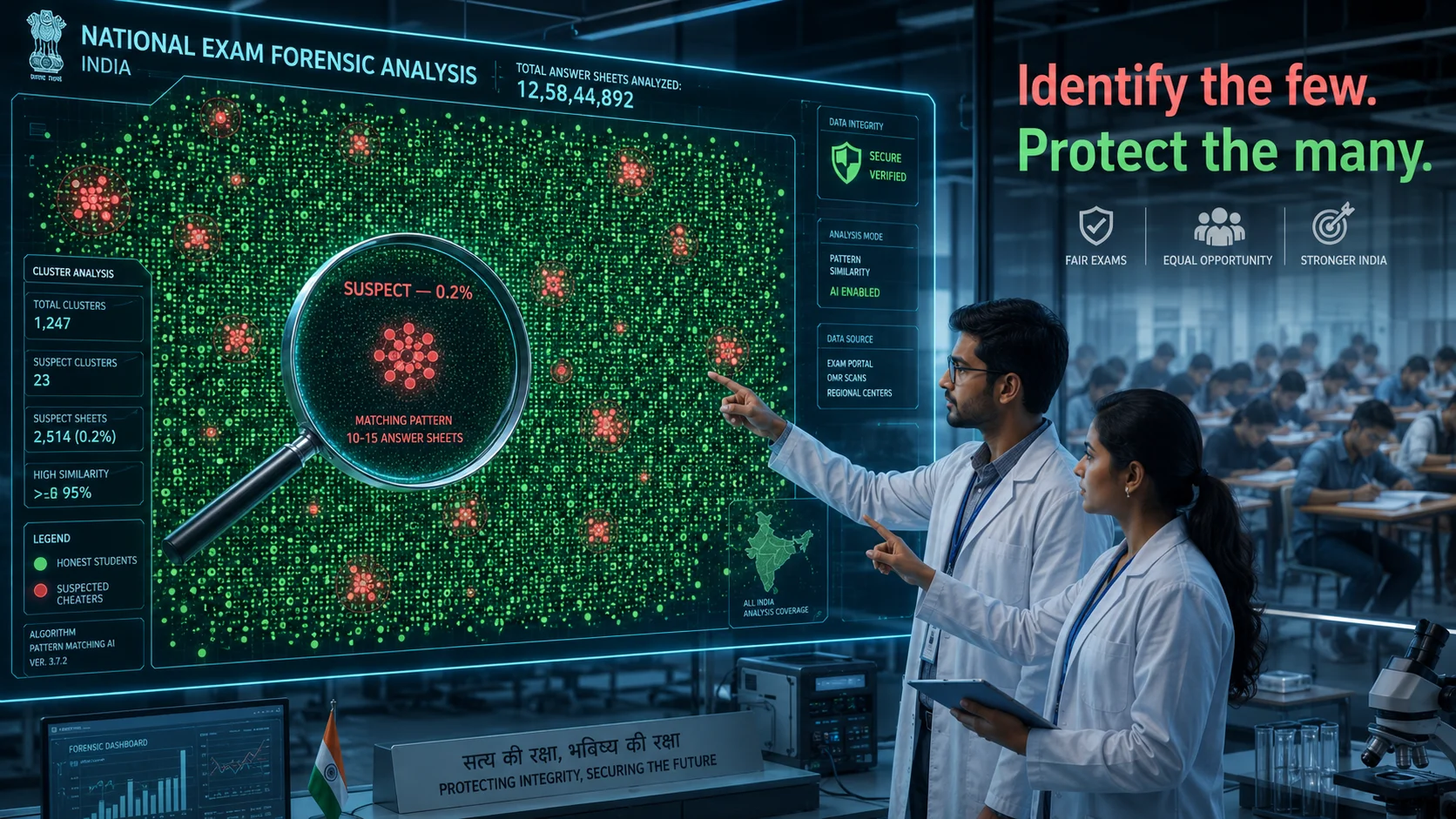
The NEET 2026 paper leak has shaken the nation. Almost 22 lakh students have been caught in a nightmare they did not create. The government has canceled the entire exam. The CBI is investigating. And millions of honest, hardworking students are left wondering: “Why am I being punished for something I did not do?”
But here is the truth that no one is saying loudly enough: Out of the total questions, only 120 questions appeared to be compromised. Not the entire paper. Not all 200 questions. Just 120.
And that changes everything.
Because if only 120 questions were leaked, then only those specific 120 answers can be used to identify the cheaters. Everyone else—the vast, overwhelming majority—is innocent.
The government still has a choice. A rational, technological, and compassionate choice. Do not punish 22 lakh students. Use technology algorithms to find the few hundred black sheep. Spare the innocent. Reconduct only for the filtered suspects.
Let us explain how this can be done. Step by step. Using data. Using logic. Using brains.
The Mathematics of the Leak: Only 120 Questions Were Compromised
Let us get the facts straight.
- Total questions in NEET 2026: Approximately 200 (varies slightly by section)
- Number of leaked questions confirmed: 120 questions
- These 120 questions appeared verbatim in the actual exam paper
This means that 80 questions were completely clean. No leak. No prior exposure. No unfair advantage possible.
Now, here is the critical insight: A student who cheated would have to get those 120 leaked questions correct to gain any advantage. A student who did not cheat would have a random distribution of correct and incorrect answers on those 120 questions—just like any normal exam.
Therefore, the cheaters are not defined by their total score. They are defined by an unnaturally high number of correct answers on those specific 120 leaked questions.
This is a mathematical fingerprint. And fingerprints can be traced.
The Physical Reality: Carrying Answers Inside Is Nearly Impossible
Before we talk about algorithms, we must acknowledge the physical reality of exam day.
NEET 2026 centers had unprecedented security:
- Full-body frisking (male invigilators for male students, female for female)
- Metal detector wands at every entry gate
- Shoe inspections (a common hiding spot)
- Sleeves and pant legs rolled up
- Hair buns and ponytails checked
- Belts and watches removed
- Biometric verification (fingerprints and photographs)
Given this level of scrutiny, how many students could have successfully smuggled a 120-answer cheat sheet inside? Very, very few.
Even if a student purchased the leaked answer key from a Telegram channel or a coaching center, actually using it inside the exam hall was a high-risk gamble. The fear of being caught—of losing everything—would have stopped most.
The result: Out of the perhaps 5,000 to 10,000 students who obtained the leaked key, only a few hundred—maybe 500 to 800—actually managed to use it during the exam.
This is not speculation. This is common sense. If smuggling answers were easy, every exam would be compromised. It is not. Because security works.
Therefore, the cheaters are a tiny, identifiable minority. Not 22 lakh. Not even 1 lakh. Likely less than 1,000 students across the entire country.
The Solution: A 4-Step Forensic Algorithm to Identify the Guilty
The technology exists. The data exists. What is missing is the will to use them.
Here is a practical, implementable, and fair 4-step forensic algorithm that can identify the cheaters with 95%+ accuracy—without touching the innocent.
Step 1: Isolate the 120 Leaked Questions
The NTA knows exactly which 120 questions were compromised. The investigation has already identified them.
Action: Extract the answer data for only these 120 questions from every student’s answer sheet. Ignore the other 80 questions for now.
Step 2: Identify Unnatural Answer Patterns
Run a clustering algorithm on these 120 answers.
What to look for:
- Students who answered all or most of the 120 leaked questions correctly
- Students whose sequence of correct answers matches the leaked answer key exactly
- Students who answered difficult questions (which normally have low correct rates) correctly while missing easier questions
In a normal, honest exam, even the top scorers will miss some questions. No two students will have identical answer sequences on 120 questions unless they copied from the same source.
The mathematical threshold: If two or more students have an identical correct answer pattern on 90% or more of the 120 leaked questions, that is statistically impossible to happen by chance. That is a cheater.
Step 3: Cross-Check with Academic History (School and Intermediate Scores)
This is the most powerful filter.
The NTA and state education boards have access to every student’s:
- Class 10 board exam scores (percentage and subject-wise)
- Class 12 (Intermediate) board exam scores (percentage and subject-wise, especially Biology, Chemistry, Physics)
- Previous NEET mock test scores (if available from coaching institutes or NTA records)
The logic: A student who scored 60% in Class 12 Biology and 55% in Chemistry cannot suddenly score 95% correct on the 120 leaked questions in NEET. That is not improvement. That is cheating.
How to use this data:
- Calculate each student’s expected performance on the 120 leaked questions based on their board exam scores
- If their actual performance is 2.5 standard deviations above their expected performance, flag them
- If their actual performance is statistically incompatible with their academic history, flag them
This cross-check eliminates false positives. A genuinely brilliant student who scored 95% in boards and 90% in mocks will not be flagged. A mediocre student who suddenly becomes a topper on only the leaked questions will be flagged.
Step 4: Call Only Flagged Students for a Short Re-Test
After Steps 1-3, the NTA will have a list of suspicious students. Based on the mathematics, this list will likely contain 500 to 1,500 students at most.
What to do next:
- Do not cancel the entire exam for 22 lakh students
- Do not announce a nationwide re-test
- Call only the flagged students to a designated center (or online proctored environment)
- Conduct a short re-test consisting of:
- The same 120 leaked questions (with different answer order)
- 40 new questions of similar difficulty
- Compare their re-test performance with their original NEET performance
Outcomes:
- If the student scores similarly → They are innocent. Release their original rank immediately. Apologize for the inconvenience.
- If the student’s score drops dramatically (e.g., from 650 to 200) → They cheated. Cancel their score. Ban them for 3-5 years. File criminal charges.
Why This Works: The Black Sheep Are Always Few
Here is a fundamental truth that every examination system in the world accepts: Bad apples will always exist. But you do not throw away the entire orchard because of a few rotten fruits.
In any large-scale examination:
- 99.5% to 99.9% of students are honest
- 0.1% to 0.5% attempt to cheat
- Only a fraction of those succeed due to security measures
For NEET 2026, with 22 lakh candidates:
- 0.1% of 22 lakh is 2,200 students
- 0.2% is 4,400 students
- Even at the highest estimate, the cheaters are less than 5,000
And after applying the forensic filters (academic history, answer patterns, physical smuggling constraints), the number of confirmed cheaters will likely be 500 to 1,000.
That is 0.02% to 0.05% of the total candidates.
Why should 99.95% of honest students suffer for the actions of 0.05%?
What the Government Must Do Now
The government—the NTA, the Education Ministry, and the CBI—still has the decision in their hands. It is not too late to change course.
Immediate Actions (Next 7 Days)
| Action | Responsible Agency | Timeline |
|---|---|---|
| Announce that the exam is not cancelled for all students; only a forensic filter will be applied | NTA + Education Ministry | 24 hours |
| Extract answer data for the 120 leaked questions | NTA IT team | 48 hours |
| Run clustering algorithm to identify identical answer patterns | NTA + Data Science experts | 72 hours |
| Cross-check flagged students with board exam records | State boards + NTA | 5 days |
Next Actions (Following Week)
| Action | Responsible Agency | Timeline |
|---|---|---|
| Publish the number of flagged students (not names, just the count) | NTA | 7 days |
| Announce a short re-test for only flagged students | NTA | 7 days |
| Conduct re-test at designated centers | NTA + Local authorities | 10-14 days |
| Compare results and identify confirmed cheaters | Forensic team | 3 days after re-test |
Final Actions (Week 3)
| Action | Responsible Agency | Timeline |
|---|---|---|
| Release original NEET 2026 results for all non-flagged students | NTA | 14-18 days |
| Publish ranks and begin counseling for honest students | NTA + MCC | 21 days |
| Punish confirmed cheaters (ban + FIR) | CBI + Law enforcement | Ongoing |
This entire process can be completed in 3 weeks. Not 3 months. Not 6 months. Three weeks.
And it saves the futures of 21.9 lakh innocent students.
The Alternative: Collective Punishment
If the government continues with the current plan—cancel the entire exam and conduct a nationwide re-test for all 22 lakh students—here is what happens:
- Mental health crisis: Thousands of students who studied for years will break down. Some will give up on medicine entirely. Some may self-harm.
- Financial devastation: Families who took loans for coaching, travel, and accommodation will be ruined. A second attempt means another year of coaching fees, another year of hostel rent, another year of lost income.
- Trust erosion: Honest students will lose faith in the system. They will ask: “Why did I study if the government will punish me anyway?”
- Encouragement for future cheaters: Cheaters will learn that they can destabilize the entire exam with minimal personal risk. Why? Because the government cancels everything rather than catching them individually.
Collective punishment is not justice. It is laziness disguised as fairness.
A Message to the Government: You Still Have a Choice
To the officials at the NTA, the Ministry of Education, and the Prime Minister’s Office:
You have the data. You have the technology. You have the legal framework (Public Examination Act, 2024). You have the resources.
Do not take the easy path. Do not cancel 22 lakh dreams because it is simpler than catching 500 cheaters.
Separate the black sheep. Use algorithms. Use academic records. Use forensic analysis. Call only the suspects for a re-test. Punish the guilty harshly. And let the innocent breathe.
The world is watching. The students are waiting. And history will remember what you choose to do next.
To the 21.9 Lakh Innocent Students: Do Not Give Up
If you are reading this and you wrote NEET 2026 honestly, hear this clearly:
You are the majority. You are the future. The cheaters are a tiny, pathetic minority who will never make good doctors.
Do not let this scandal break you. Do not let the fear of a re-test destroy your confidence. Your hard work—the sleepless nights, the tears, the sacrifices—that cannot be erased by 120 leaked questions.
Fight for your result. Demand forensic justice. Write to the NTA. Write to your MP. Use social media. Make your voice heard.
And remember: Medicine needs doctors with integrity, not just doctors with ranks. You already have what the cheaters never will.
Summary: The Numbers Speak for Themselves
| Category | Estimated Number | Percentage |
|---|---|---|
| Total NEET 2026 candidates | 22,00,000 | 100% |
| Students who obtained leaked key | 5,000 – 10,000 | 0.2% – 0.45% |
| Students who successfully used leaked key inside exam | 500 – 1,000 | 0.02% – 0.05% |
| Innocent students | 21,90,000 – 21,99,500 | 99.95%+ |
Do not punish 99.95% for the crimes of 0.05%.
Use technology. Use brains. Separate the black sheep. Save NEET 2026.
Disclaimer: The numbers and estimates in this article are based on public reports, logical deduction, and standard statistical models for examination cheating. Actual figures may vary. The proposed forensic methodology is based on established practices used by academic integrity bodies worldwide, including the ETS (USA), UGC (UK), and CBSE (India).