 ratminers.in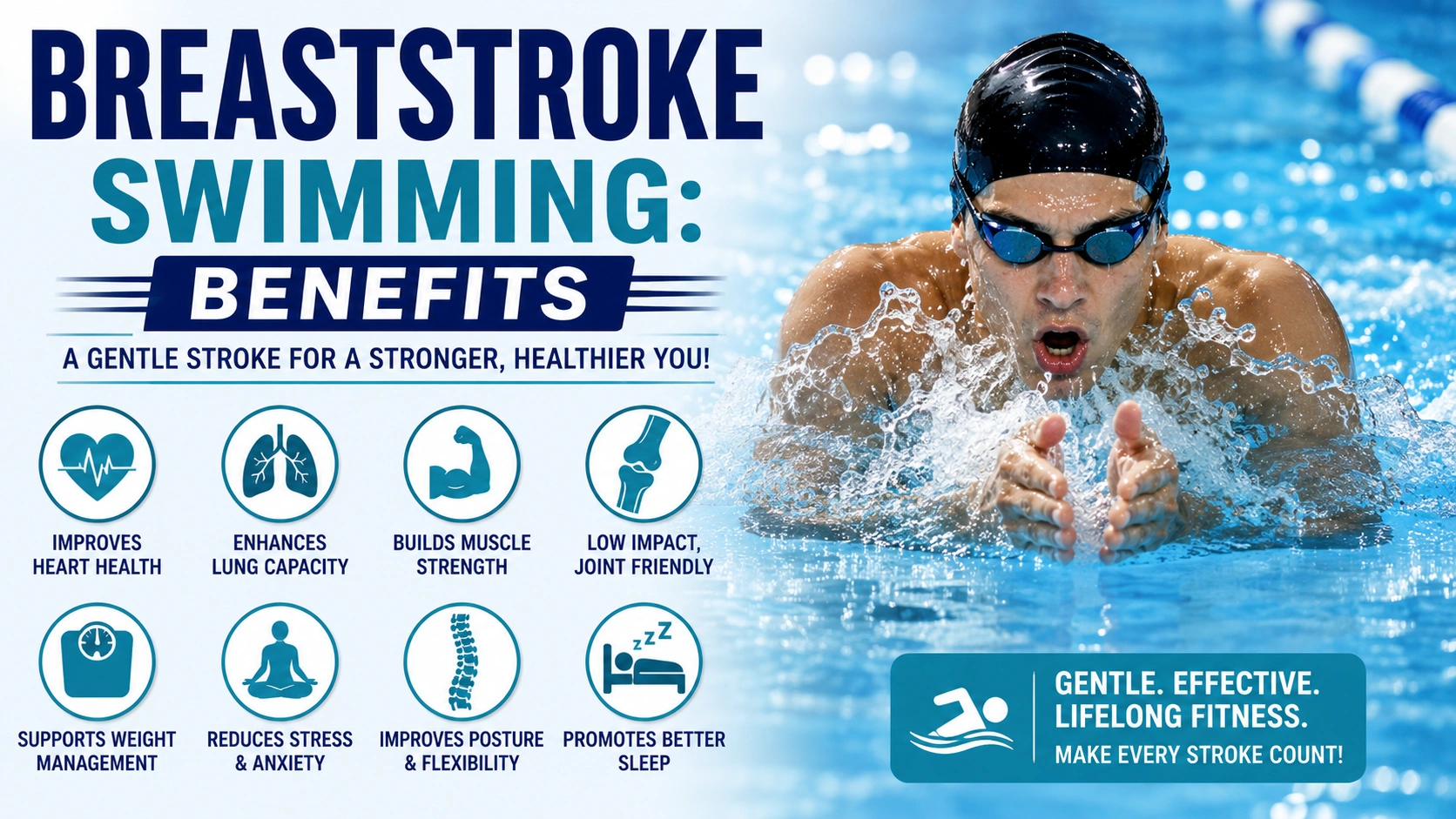
What is breaststroke in swimming? Breaststroke is one of the four competitive swimming strokes (along with freestyle, backstroke, and butterfly). It is performed face down in the water with simultaneous arm pulls and a distinctive “frog-like” or whip kick.
Swimmers pull both arms outward and backward together, breathe during the pull, kick with both legs, and glide forward in a streamlined position. It is the slowest of the competitive strokes but highly technical and accessible for many swimmers to understand 10 Amazing Benefits of Breaststroke for Ladies
What Are the 4 Types of Swimming?
The four main competitive swimming strokes are:
- Freestyle (front crawl): The fastest and most efficient stroke.
- Backstroke: Swum on the back with alternating arm pulls.
- Breaststroke: Simultaneous arm and leg movements with a glide phase.
- Butterfly: Undulating body motion with simultaneous arm recovery over the water.
These form the basis of individual medley events, where swimmers use all four in sequence.
Breaststroke Swimming Benefits
Breaststroke offers numerous advantages as a low-impact, full-body workout suitable for all ages and fitness levels:
- Full-body muscle engagement and strengthening — It tones the chest, shoulders, arms, upper back, core, glutes, inner thighs, hamstrings, and lower legs. The whip kick particularly targets the adductors and hip flexors.
- Cardiovascular endurance — It elevates heart rate, improves lung capacity, and supports heart health, even though it is slower than other strokes.
- Low-impact exercise — Gentle on joints, making it ideal for rehabilitation, older adults, or those with mobility concerns.
- Improved posture and flexibility — The chest-opening arm motion and hip/ankle flexibility from the kick can counteract rounded shoulders from daily life.
- Calorie burning and weight management — It can burn around 200–700 calories per hour depending on intensity and body size, while being sustainable for longer swims.
- Mental well-being and stress relief — The rhythmic, steady pace promotes relaxation and can feel meditative.
- Coordination and balance — Requires precise timing between arms, legs, and breathing.
It is especially beginner-friendly for recreational swimming and serves as a great recovery or endurance option in training.
Breaststroke Swimming Technique
The breaststroke cycle follows this sequence: pull → breathe → kick → glide.
- Body position — Stay as horizontal and streamlined as possible. Keep hips high, head in line with the spine (eyes looking down), and avoid excessive up-and-down motion.
- Arm pull — Start with arms extended forward (streamline). Sweep hands outward and slightly downward (palms out), then pull back with high elbows toward the chest in a heart- or triangle-shaped motion. Accelerate the inward sweep.
- Breathing — Lift your head (chin forward, not too high) to inhale as the arms pull inward. Exhale underwater as the arms recover forward.
- Leg kick (whip kick) — From a streamlined position, flex feet and draw heels toward the buttocks with knees close together (narrower than shoulders). Turn feet outward and sweep them in a circular “whip” motion, snapping them together forcefully for propulsion. The kick provides more power than the arms in breaststroke.
- Glide — Extend arms forward and hold a streamlined position for 1–2 seconds after each cycle to maximize efficiency and reduce drag.
Focus on timing: Pull and breathe first, then kick during arm recovery, and glide. Poor timing creates drag and slows you down.
Breaststroke Swimming Technique for Beginners
Start simple and build coordination:
- Practice on land or with a kickboard first.
- Use the cue: Pull, breathe, kick, glide.
- Keep the pull narrow (not too wide) to reduce shoulder strain.
- Maintain a compact kick with knees close.
- Glide longer to feel the forward momentum.
Begin with short distances, focusing on one element at a time (e.g., arms only with flutter kick, then legs only on back). Many beginners find it intuitive because the head can stay mostly above water for breathing.
Breaststroke Breathing
Breathing is synchronized with the arm pull:
- As your hands sweep inward during the pull, lift your chin slightly to inhale through the mouth.
- Drop your head back into the water as arms extend forward and exhale through mouth and nose.
- Avoid lifting the head too high, as this sinks the hips and increases drag. Keep the motion quick and minimal.
Practice “trickle breathing” (slow exhale) to stay relaxed. Many swimmers breathe every stroke in breaststroke.
Breaststroke Swimming Exercises and Drills
Incorporate these drills to improve technique:
- Streamline kick (on stomach or back) — Focus on body line and glide.
- Heel tag — Emphasize narrow knees and strong whip.
- 2 kicks, 1 pull — Builds timing and glide.
- Breaststroke arms with flutter or dolphin kick — Isolates arms while keeping legs moving.
- Pull with pull buoy — Works upper body.
- Sculling drills — Improves feel for the water during the pull.
Dryland exercises like adductor rocks, hip circles, and scapular pull-downs can strengthen supporting muscles.
The 5 Most Important Things in Breaststroke
According to coaching insights, prioritize these for efficiency and speed:
- Timing — Pull-breathe-kick-glide sequence is critical; overlap or poor sync creates massive drag.
- Ankle flexibility and circular kick — Flexible ankles create a powerful whip.
- Narrow knees — Keep kick compact within body line to minimize resistance.
- Quick breath — Fast, low head lift to maintain horizontal position.
- High hips and streamlined glide — Stay level and pause in streamline for maximum distance per stroke.
Is Swimming Breaststroke Good for Rotator Cuff Injury?
Yes, breaststroke is often considered one of the safest strokes for shoulder issues like rotator cuff injuries. The arms remain mostly underwater with no overhead recovery, reducing impingement risk compared to freestyle or butterfly. It minimizes joint compression while still providing gentle strengthening for chest, back, and shoulder stabilizers. However, improper technique (e.g., pulling too wide or lifting the head excessively) can still strain shoulders or neck. Always consult a doctor or physical therapist before resuming, start slowly, and focus on good form. Backstroke or modified strokes may also be options depending on the injury.
Is Breaststroke the Hardest Stroke?
It depends on the context:
- Easiest for beginners/recreational swimmers — Many find it intuitive and relaxing.
- One of the hardest to master perfectly or swim fast — It demands precise timing, coordination, flexibility (especially ankles and hips), and strength to overcome high drag. Small errors kill efficiency more than in other strokes. Butterfly is often hardest to learn initially, but breaststroke can feel the most technically demanding for competitive performance and long-distance efficiency.
Many competitive swimmers and officials call it the most challenging stroke due to the number of disqualification rules and the need for perfect rhythm.
Breaststroke Swimming Video Search YouTube for tutorials like “How To Swim Breaststroke For Beginners” or “Breaststroke Technique Drills” from reputable swimming channels for visual demonstrations.
Breaststroke is a versatile, rewarding stroke whether you swim for fitness, recovery, or competition. Focus on smooth timing and glide for the best results. If you’re new to it, consider lessons from a qualified instructor to build proper habits early.Breaststroke Swimming: Benefits, Technique, and Everything You Need to Know
What is breaststroke in swimming? Breaststroke is one of the four competitive swimming strokes (along with freestyle, backstroke, and butterfly). It is performed face down in the water with simultaneous arm pulls and a distinctive “frog-like” or whip kick. Swimmers pull both arms outward and backward together, breathe during the pull, kick with both legs, and glide forward in a streamlined position. It is the slowest of the competitive strokes but highly technical and accessible for many swimmers.
What Are the 4 Types of Swimming?
The four main competitive swimming strokes are:
- Freestyle (front crawl): The fastest and most efficient stroke.
- Backstroke: Swum on the back with alternating arm pulls.
- Breaststroke: Simultaneous arm and leg movements with a glide phase.
- Butterfly: Undulating body motion with simultaneous arm recovery over the water.
These form the basis of individual medley events, where swimmers use all four in sequence.
Breaststroke Swimming Benefits
Breaststroke offers numerous advantages as a low-impact, full-body workout suitable for all ages and fitness levels:
- Full-body muscle engagement and strengthening — It tones the chest, shoulders, arms, upper back, core, glutes, inner thighs, hamstrings, and lower legs. The whip kick particularly targets the adductors and hip flexors.
- Cardiovascular endurance — It elevates heart rate, improves lung capacity, and supports heart health, even though it is slower than other strokes.
- Low-impact exercise — Gentle on joints, making it ideal for rehabilitation, older adults, or those with mobility concerns.
- Improved posture and flexibility — The chest-opening arm motion and hip/ankle flexibility from the kick can counteract rounded shoulders from daily life.
- Calorie burning and weight management — It can burn around 200–700 calories per hour depending on intensity and body size, while being sustainable for longer swims.
- Mental well-being and stress relief — The rhythmic, steady pace promotes relaxation and can feel meditative.
- Coordination and balance — Requires precise timing between arms, legs, and breathing.
It is especially beginner-friendly for recreational swimming and serves as a great recovery or endurance option in training.
Breaststroke Swimming Technique
The breaststroke cycle follows this sequence: pull → breathe → kick → glide.
- Body position — Stay as horizontal and streamlined as possible. Keep hips high, head in line with the spine (eyes looking down), and avoid excessive up-and-down motion.
- Arm pull — Start with arms extended forward (streamline). Sweep hands outward and slightly downward (palms out), then pull back with high elbows toward the chest in a heart- or triangle-shaped motion. Accelerate the inward sweep.
- Breathing — Lift your head (chin forward, not too high) to inhale as the arms pull inward. Exhale underwater as the arms recover forward.
- Leg kick (whip kick) — From a streamlined position, flex feet and draw heels toward the buttocks with knees close together (narrower than shoulders). Turn feet outward and sweep them in a circular “whip” motion, snapping them together forcefully for propulsion. The kick provides more power than the arms in breaststroke.
- Glide — Extend arms forward and hold a streamlined position for 1–2 seconds after each cycle to maximize efficiency and reduce drag.
Focus on timing: Pull and breathe first, then kick during arm recovery, and glide. Poor timing creates drag and slows you down.
Breaststroke Swimming Technique for Beginners
Start simple and build coordination:
- Practice on land or with a kickboard first.
- Use the cue: Pull, breathe, kick, glide.
- Keep the pull narrow (not too wide) to reduce shoulder strain.
- Maintain a compact kick with knees close.
- Glide longer to feel the forward momentum.
Begin with short distances, focusing on one element at a time (e.g., arms only with flutter kick, then legs only on back). Many beginners find it intuitive because the head can stay mostly above water for breathing.
Breaststroke Breathing
Breathing is synchronized with the arm pull:
- As your hands sweep inward during the pull, lift your chin slightly to inhale through the mouth.
- Drop your head back into the water as arms extend forward and exhale through mouth and nose.
- Avoid lifting the head too high, as this sinks the hips and increases drag. Keep the motion quick and minimal.
Practice “trickle breathing” (slow exhale) to stay relaxed. Many swimmers breathe every stroke in breaststroke.
Breaststroke Swimming Exercises and Drills
Incorporate these drills to improve technique:
- Streamline kick (on stomach or back) — Focus on body line and glide.
- Heel tag — Emphasize narrow knees and strong whip.
- 2 kicks, 1 pull — Builds timing and glide.
- Breaststroke arms with flutter or dolphin kick — Isolates arms while keeping legs moving.
- Pull with pull buoy — Works upper body.
- Sculling drills — Improves feel for the water during the pull.
Dryland exercises like adductor rocks, hip circles, and scapular pull-downs can strengthen supporting muscles.
The 5 Most Important Things in Breaststroke
According to coaching insights, prioritize these for efficiency and speed:
- Timing — Pull-breathe-kick-glide sequence is critical; overlap or poor sync creates massive drag.
- Ankle flexibility and circular kick — Flexible ankles create a powerful whip.
- Narrow knees — Keep kick compact within body line to minimize resistance.
- Quick breath — Fast, low head lift to maintain horizontal position.
- High hips and streamlined glide — Stay level and pause in streamline for maximum distance per stroke.
Is Swimming Breaststroke Good for Rotator Cuff Injury?
Yes, breaststroke is often considered one of the safest strokes for shoulder issues like rotator cuff injuries. The arms remain mostly underwater with no overhead recovery, reducing impingement risk compared to freestyle or butterfly. It minimizes joint compression while still providing gentle strengthening for chest, back, and shoulder stabilizers. However, improper technique (e.g., pulling too wide or lifting the head excessively) can still strain shoulders or neck. Always consult a doctor or physical therapist before resuming, start slowly, and focus on good form. Backstroke or modified strokes may also be options depending on the injury.
Is Breaststroke the Hardest Stroke?
It depends on the context:
- Easiest for beginners/recreational swimmers — Many find it intuitive and relaxing.
- One of the hardest to master perfectly or swim fast — It demands precise timing, coordination, flexibility (especially ankles and hips), and strength to overcome high drag. Small errors kill efficiency more than in other strokes. Butterfly is often hardest to learn initially, but breaststroke can feel the most technically demanding for competitive performance and long-distance efficiency.
Many competitive swimmers and officials call it the most challenging stroke due to the number of disqualification rules and the need for perfect rhythm.
Breaststroke Swimming Video Search YouTube for tutorials like “How To Swim Breaststroke For Beginners” or “Breaststroke Technique Drills” from reputable swimming channels for visual demonstrations.
Breaststroke is a versatile, rewarding stroke whether you swim for fitness, recovery, or competition. Focus on smooth timing and glide for the best results. If you’re new to it, consider lessons from a qualified instructor to build proper habits early.
Important Note: This is general information for educational purposes. Consult a healthcare professional for personalized advice, especially regarding injuries or medical conditions. Technique can vary slightly by coaching philosophy—experiment safely in the pool!
Important Note: This is general information for educational purposes. Consult a healthcare professional for personalized advice, especially regarding injuries or medical conditions. Technique can vary slightly by coaching philosophy—experiment safely in the pool!