 ratminers.in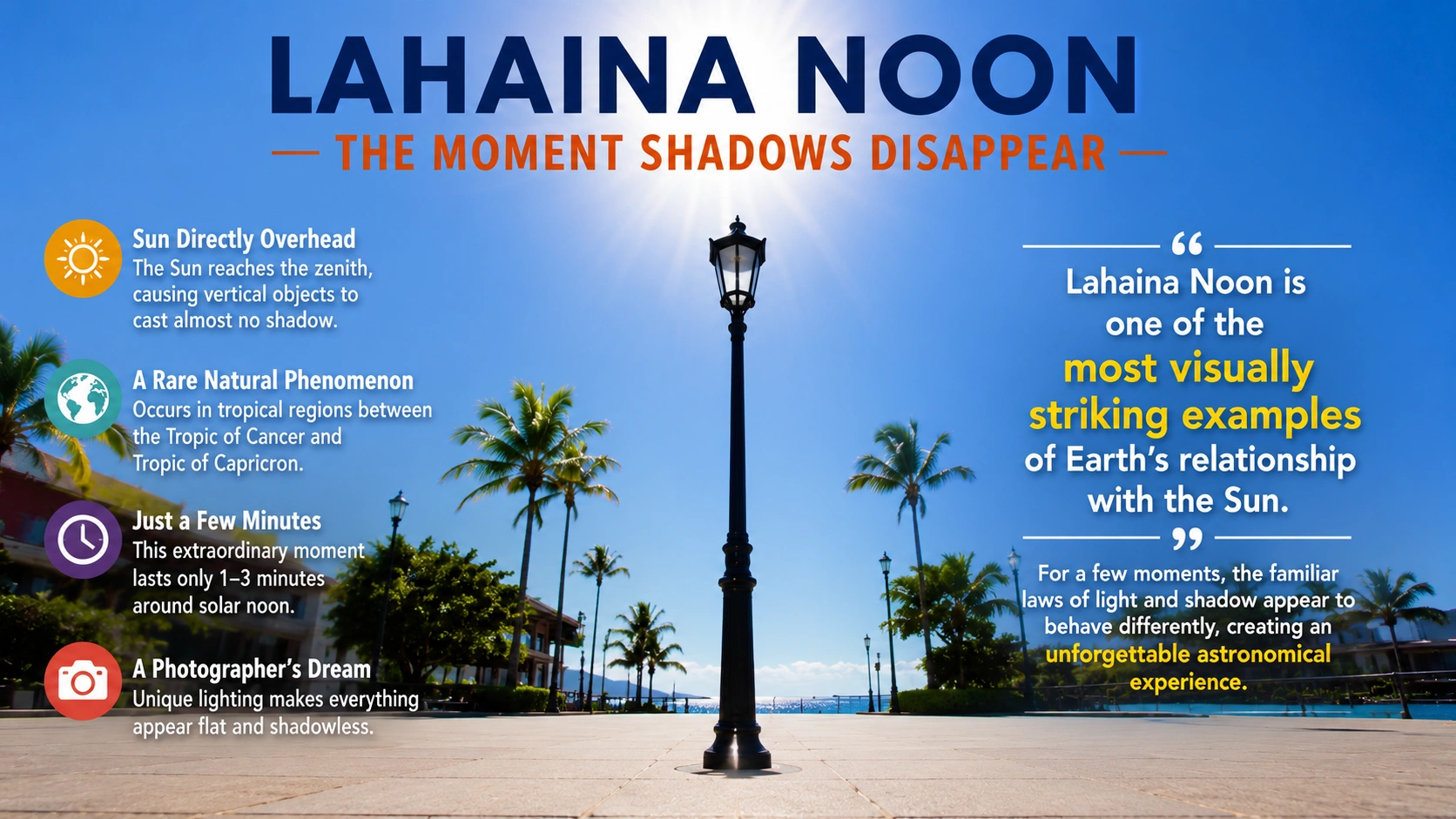
Lahaina Noon is a rare astronomical event during which the Sun appears directly overhead, causing vertical objects to cast almost no visible shadow for a brief period around local noon, causing a Zero Shadow Day.
The phenomenon is also popularly known as:
- Zero Shadow Day
- Shadowless Noon
- Zenith Sun phenomenon
It may sound like something from a science-fiction movie or a desert planet in Dune, but it is a completely real celestial event observed in tropical regions on Earth.
For a few magical moments:
- Trees appear shadowless
- Buildings lose their outlines
- Lamp posts seem to float
- Even human bodies cast almost no shadow
🌞 Zero Shadow Day
Hyderabad 2026
At exactly 12:12 PM, vertical objects cast almost NO visible shadow.
Hyderabad lies between the Tropic of Cancer and Tropic of Capricorn, allowing the Sun to appear directly overhead twice yearly.
🛡️ Safety Checklist
- Use umbrella, hat & sunglasses
- Apply SPF 50+ sunscreen
- Drink coconut water or buttermilk
- Avoid direct sun exposure longer than 5 minutes
- Move to shade immediately after observing
💧 Hydration Tips
- Coconut water helps replenish potassium
- Homemade ORS improves hydration
- Avoid excess caffeine and soda
- Drink cool — not ice-cold — water
As the British band Oasis once wrote:
“As he faced the sun, he cast no shadow.”
While poetic in the song, astronomy occasionally makes that image a reality.
Why Is It Called “Lahaina Noon”?
The name “Lāhainā Noon” originated in Hawaii.
The term was popularised by the Bishop Museum to describe the moment when the Sun reaches the zenith directly above the Hawaiian Islands.
“Lāhainā” is a Hawaiian word roughly meaning:
- “Cruel Sun”
- “Merciless Sun”
a fitting description for the intense overhead sunlight experienced during the event.
What Causes Lahaina Noon?
The phenomenon happens because Earth is tilted by approximately 23.5 degrees as it revolves around the Sun.
23.5∘23.5^{\circ}23.5∘
This tilt causes the Sun’s apparent movement between:
- The Tropic of Cancer
- The Tropic of Capricorn
When the Sun’s declination perfectly matches a location’s latitude, sunlight falls vertically overhead at noon.
At that exact moment:
- Shadows shrink dramatically
- Vertical objects cast almost no visible shadow
- The Sun appears at the zenith
Where Can Lahaina Noon Be Seen?
Lahaina Noon can only occur in places located between:
- 23.5° North latitude
- 23.5° South latitude
This includes many tropical regions such as:
- India
- Hawaii
- Parts of Africa
- Southeast Asia
- Central America
- Northern Australia
Cities like:
- Hyderabad
- Chennai
- Bengaluru
experience similar Zero Shadow Day events twice every year.Lahaina Noon: Most Searched Questions Answered
What Is Lahaina Noon?
Lahaina Noon is a rare celestial event during which the Sun appears directly overhead at local noon, causing vertical objects to cast almost no shadow.
It is also known as:
- Zero Shadow Day
- Shadowless Noon
- Zenith Sun phenomenon
The event occurs only in tropical regions located between:
- Tropic of Cancer
- Tropic of Capricorn
What’s the Science Behind Lāhainā Noon?
The science behind Lahaina Noon is based on Earth’s axial tilt and solar geometry.
Earth is tilted by approximately:
23.5∘23.5^{\circ}23.5∘
As Earth revolves around the Sun:
- The Sun appears to move northward and southward during the year
- This changes the Sun’s declination angle
When the Sun’s declination exactly matches a location’s latitude:
- Sunlight falls vertically overhead
- Shadows shrink beneath objects
- The “zero shadow” effect appears
What Is the Science Behind Zero Shadow Day?
Zero Shadow Day happens because sunlight strikes the Earth at a perfectly vertical angle at specific tropical latitudes.
This causes:
- Minimal shadow formation
- Maximum solar intensity
- Peak UV exposure
The event helps explain:
- Latitude and longitude
- Solar movement
- Seasonal cycles
- Earth-Sun relationships
Science educators often use it to demonstrate astronomy concepts in real life.
Why Does Lāhainā Noon Only Happen in Hawaii?
Technically, it does not happen only in Hawaii.
The name “Lāhainā Noon” originated there, but similar zero-shadow events occur across many tropical countries including:
- India
- Mexico
- Thailand
- Indonesia
- Brazil
- Philippines
The Hawaiian term became popular because the phenomenon was formally promoted there by the Bishop Museum.
Why Is Lahaina Historically Significant?
Lahaina was historically one of Hawaii’s most important royal and cultural centers.
The word “Lāhainā” roughly translates to:
- “Cruel Sun”
- “Merciless Sun”
because of the region’s intense tropical sunlight.
The phenomenon gained global attention because Hawaiian astronomers and educators popularized public observations of the overhead Sun event.
How Long Does Lahaina Noon Last?
The actual shadowless effect usually lasts:
- Around 1 to 3 minutes
However:
- The shortening and shifting of shadows can be observed for 15–20 minutes around solar noon.
Exact duration depends on:
- Latitude
- Season
- Solar angle
- Atmospheric conditions
Lahaina Noon 2026
In 2026, many tropical locations including parts of:
- India
- Hawaii
will experience Lahaina Noon twice during the year.
Cities such as:
- Hyderabad
- Chennai
- Bengaluru
will witness similar Zero Shadow Day events around:
- May
- July
Lahaina Noon 2027
The phenomenon will continue in 2027 because it is caused by Earth’s predictable orbit and axial tilt.
Dates vary slightly every year depending on:
- Solar declination
- Leap year effects
- Geographic coordinates
Astronomical observatories usually release updated yearly schedules.
Lahaina Noon Calculator
A Lahaina Noon calculator estimates:
- Date
- Time
- Solar zenith angle
- Latitude alignment
using:
- Geographic coordinates
- Solar declination formulas
- Astronomical calculations
Such calculators are commonly used by:
- Astronomy enthusiasts
- Science educators
- Observatories
Lahaina Noon Map
A Lahaina Noon map usually highlights regions located between:
- 23.5° North
- 23.5° South
Only places inside this tropical belt can experience the event.
Lahaina Noon Tracker
Online astronomy trackers monitor:
- Solar position
- Zenith timing
- Sun declination
- Upcoming Zero Shadow Days
These trackers help users identify:
- Exact observation time
- Duration
- Best viewing conditions
Lahaina Noon Pronunciation
The correct pronunciation of “Lāhainā” is approximately:
“Lah-HIGH-nah”
The long Hawaiian vowels slightly extend the sound.
Lahaina Noon Photos
Photos of Lahaina Noon often show:
- Disappearing shadows
- Shadow directly beneath objects
- Buildings appearing unusually flat
- People standing seemingly shadowless
Popular photography subjects include:
- Poles
- Trees
- Monuments
- Human silhouettes
Lahaina Noon is one of the most visually striking examples of Earth’s relationship with the Sun. For a few moments, the familiar laws of light and shadow appear to behave differently, creating an unforgettable astronomical experience.
What looks almost supernatural is actually a beautiful demonstration of:
- Earth’s axial tilt
- Solar movement
- Celestial precision
- Tropical geography
It is a reminder that astronomy is not distant science — it happens right above us every day.
What Happens During Lahaina Noon?
As noon approaches:
- Shadows become shorter and shorter
- Objects appear unusually flat
- The shadow retreats directly beneath the object
At the peak moment:
- Shadows nearly disappear
- The Sun is directly overhead
- The effect lasts only a few minutes
You can observe it by placing:
- A bottle
- A stick
- A pencil
- Or yourself
on a flat surface under direct sunlight.
Why Is Lahaina Noon Scientifically Important?
Astronomers and educators use Lahaina Noon to explain important scientific concepts such as:
- Earth’s axial tilt
- Solar movement
- Latitude and longitude
- Seasonal changes
- Solar geometry
- Celestial mechanics
Schools, science centres, and astronomy clubs often organise public demonstrations to help students understand how Earth and the Sun interact.
Is Lahaina Noon Dangerous?
Although beautiful, the phenomenon occurs during the most intense sunlight hours of the day.
During Lahaina Noon:
- UV radiation peaks
- Heat stress risk increases
- Sunburn risk becomes higher
- Dehydration occurs faster
This is especially important in tropical summers like those in India.
People observing the event should:
- Stay hydrated
- Wear sunscreen
- Use umbrellas or hats
- Avoid prolonged exposure
Final Thoughts
Lahaina Noon is one of the most visually fascinating examples of Earth’s relationship with the Sun. For a few extraordinary moments, shadows vanish, reminding us how precisely our planet moves through space.
What feels like science fiction is actually a breathtaking display of astronomy happening right above our heads — proof that the Sun, besides making life on Earth possible, occasionally creates moments that feel almost magical.
Why Hyderabad Experiences Zero Shadow Day
Hyderabad is set to witness the fascinating astronomical phenomenon known as Zero Shadow Day, a rare event during which the Sun appears directly overhead at noon, causing vertical objects to cast almost no visible shadow.
This phenomenon occurs only in locations situated between:
- Tropic of Cancer (23.5° North latitude)
- Tropic of Capricorn (23.5° South latitude)
Because Hyderabad lies at approximately 17.4° North latitude, the city experiences Zero Shadow Day twice every year.
The event generally takes place around:
- Mid-May
- Late July
The exact timing changes slightly each year based on solar calculations and Earth’s orbital position.
During the phenomenon, objects such as:
- Streetlights
- Buildings
- Trees
- Poles
- Human bodies
appear to briefly “lose” their shadows around local solar noon.
Why Does Zero Shadow Day Happen?
The phenomenon occurs because Earth’s axis is tilted by approximately 23.5 degrees as it revolves around the Sun.
This axial tilt is responsible for:
- Seasonal changes
- Solar movement across hemispheres
- Variations in daylight duration
As Earth moves around the Sun:
- The Sun appears to shift northward during Uttarayan
- The Sun appears to move southward during Dakshinayan
Because of this apparent movement, the Sun’s vertical position gradually shifts between the northern and southern tropics throughout the year.
When the Sun’s declination exactly matches the latitude of a specific place, sunlight falls vertically overhead at noon.
This creates the dramatic “zero shadow” effect.
Why Is Zero Shadow Day Scientifically Important?
Astronomers and science educators consider Zero Shadow Day an important educational event because it helps explain several fundamental scientific concepts, including:
- Earth’s axial tilt
- Change of seasons
- Apparent solar movement
- Latitude and longitude
- Solar geometry
- Astronomical calculations
Science centres, schools, observatories, and astronomy clubs often organise:
- Public demonstrations
- Educational workshops
- Shadow experiments
- Student observation sessions
These activities help students understand how Earth and the Sun interact with remarkable precision.
The event also highlights the accuracy of celestial movements and demonstrates how astronomy influences everyday life, calendars, navigation, climate understanding, and seasonal cycles.
What You Can Observe During Zero Shadow Day
As the exact moment approaches:
- Shadows become shorter and shorter
- The shadow shrinks directly beneath the object
- Vertical objects appear almost shadowless
You can try this experiment using:
- A bottle
- A stick
- A ruler
- A tripod
- Your own body
The effect lasts only for a brief period around solar noon before shadows begin to lengthen again in the opposite direction.
Important Heat Safety Reminder
Although Zero Shadow Day is scientifically exciting, it also occurs during the hottest part of the day in peak summer conditions.
In Hyderabad, temperatures during May can exceed 40°C, increasing the risk of:
- Heat Stress
- Heat Stroke
- Dehydration
- UV burns
- Electrolyte imbalance
Visitors observing the event should:
- Stay hydrated
- Carry ORS or coconut water
- Wear sunscreen
- Use umbrellas or caps
- Avoid prolonged direct sun exposure
The event may last only a few minutes, but the midday Sun can still be extremely intense.