 ratminers.in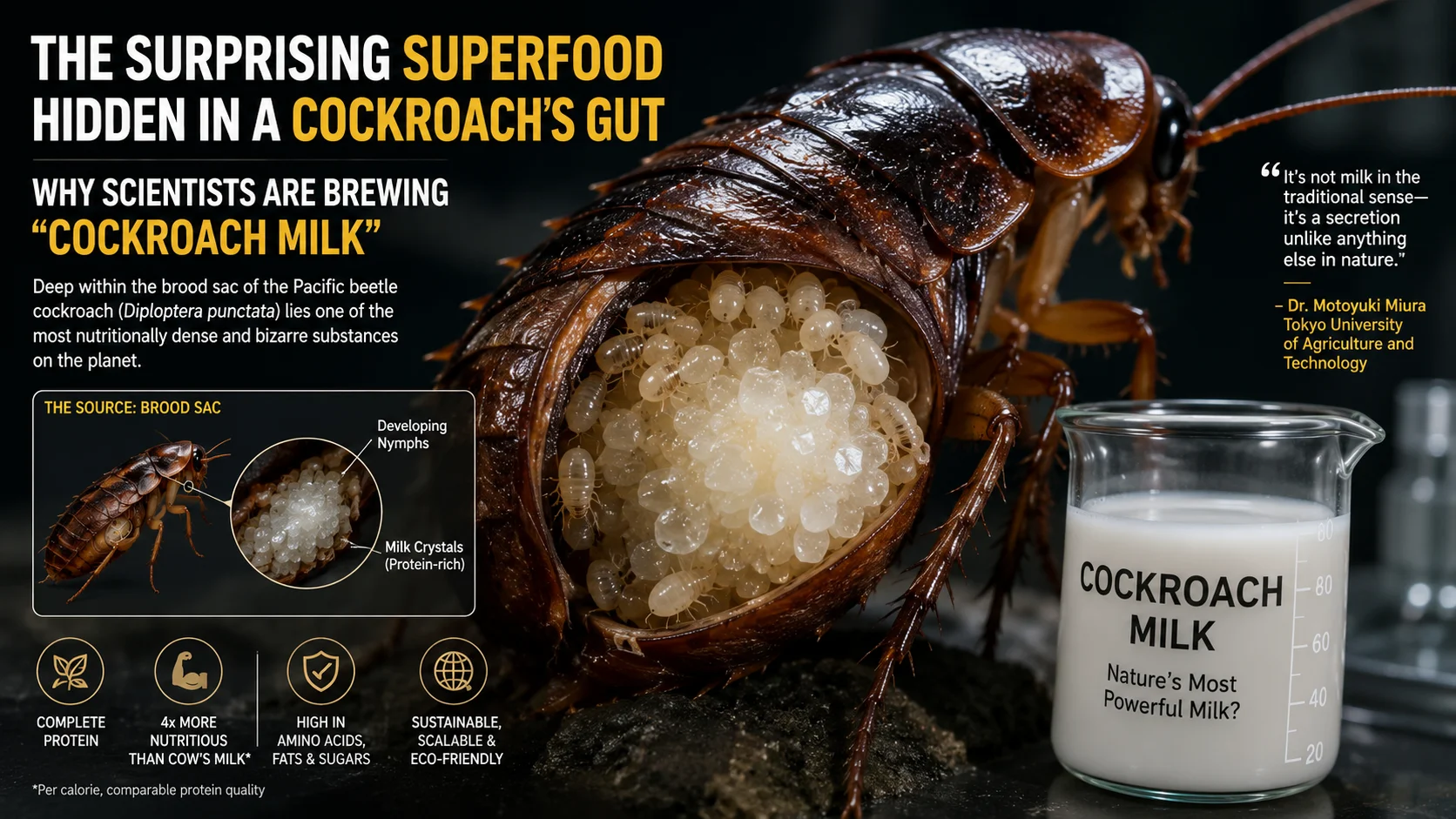
Move over, almond and oat — there’s a new alternative milk in town, and it comes from one of the most unexpected sources imaginable. The Pacific beetle cockroach (Diploptera punctata) produces a nutrient-dense crystalline substance that scientists are calling “cockroach milk,” and its nutritional profile is nothing short of astonishing .
But how does it actually compare to the cow’s milk sitting in your refrigerator right now? Let’s break down the numbers, the science, and the reality of this bizarre superfood.
Do Cockroaches Actually Produce Milk?
First, let’s clear up what we’re talking about. Unlike cow’s milk, which comes from mammary glands, cockroach milk isn’t “milk” in the traditional sense . The Pacific beetle cockroach is unique among cockroaches because it gives birth to live offspring rather than laying eggs . To nourish its developing young, the mother secretes a pale, yellowish fluid from her brood sac that crystallizes into dense protein crystals inside the embryos’ midguts .
Scientists call this “milk” because it serves the same purpose — feeding offspring — but it’s technically a crystallized lipoprotein secretion .
The Nutritional Numbers: Side by Side
Here’s what the research shows when we compare cockroach milk to traditional cow’s milk per 100 grams/milliliters:
| Nutrient | Cow’s Milk (100ml) | Cockroach Milk (100g) |
|---|---|---|
| Calories | 60-70 | 232-700* |
| Protein | 3.2-3.4g | 40-45g |
| Fat | 3.3g | 8-10g |
| Carbohydrates | 5g | 15-25g |
| Essential Amino Acids | Complete | Complete |
| Lactose | Yes | No |
*Note: Calorie estimates vary significantly across studies. One cup (250ml) of cockroach milk is estimated to contain approximately 700 calories — more than three times the calories in a cup of cow’s milk . Other sources peg it at 232 calories per 100g .
Protein: Where Cockroach Milk Dominates
The most striking difference is protein content. Cockroach milk contains approximately 40-45 grams of protein per 100 grams . Cow’s milk, by comparison, delivers just 3.2-3.4 grams per 100ml .
In fact, the protein content of cockroach milk is estimated to be four times higher than cow’s milk per gram .
Even more impressive: cockroach milk contains all nine essential amino acids — the building blocks of protein that your body cannot produce on its own . This makes it a “complete” protein, a rarity among non-meat foods . Researchers describe it as “a complete food — they have proteins, fats, and sugars” .
Calories and Energy Density
Cockroach milk is extraordinarily calorie-dense. According to the 2016 study published in the Journal of the International Union of Crystallography, cockroach milk contains three times the calories of buffalo milk, which was previously considered the most calorie-rich mammalian milk .
One analysis suggests that a single protein crystal from cockroach milk holds more than three times the energy of an equivalent mass of dairy milk .
For context, here’s how different milk types compare per 100 grams :
| Type of Milk | Calories (per 100g) |
|---|---|
| Cockroach Milk | 232 |
| Buffalo Milk | 110 |
| Cow Milk | 66 |
| Human Milk | 60 |
This high caloric density could be valuable for malnutrition relief or survival situations — but it’s a drawback for anyone watching their weight .
Fat and Carbohydrate Composition
Cockroach milk contains 8-10g of fat and approximately 15-25g of carbohydrates per 100g . The fat profile is notable: it includes beneficial fatty acids such as oleic acid, linoleic acid, and omega-3 fatty acids .
The carbohydrate content includes N-acetyl-D-glucosamine and β-D-mannose, among other compounds .
Cow’s milk, by comparison, contains about 3.3g of fat and 5g of carbohydrates per 100ml, along with essential vitamins like B12, D, and calcium that are crucial for bone health . It’s worth noting that the vitamin and mineral profile of cockroach milk hasn’t been as thoroughly studied as its macronutrients.
The Time-Release Advantage
Perhaps the most fascinating difference isn’t just what cockroach milk contains, but how it works in the body. Unlike cow’s milk proteins, which digest relatively quickly, cockroach milk forms a suspension-crystal structure that acts like a time-release capsule. As it passes through the digestive system, the outer layers are stripped away methodically, providing a steady stream of amino acids and lipids for an extended period .
This sustained release of energy could make cockroach milk particularly valuable for endurance athletes, military personnel, or anyone needing long-lasting nutrition without frequent meals.
The Major Downsides (And There Are Several)
Before you rush out to replace your morning latte with cockroach milk, let’s be realistic about the significant drawbacks.
1. No Safety Data for Humans
There is currently no research demonstrating that cockroach milk is safe for human consumption . Zero human trials have been conducted. Potential allergy concerns exist, particularly for people with shellfish allergies, since both are arthropods.
2. Production Is a Nightmare
Harvesting cockroach milk is currently a labor-intensive process that involves killing female cockroaches and their embryos once they begin to lactate, collecting the crystals from their midguts . Researchers estimate it would require more than 1,000 dead cockroaches to produce just 3.5 ounces (100 grams) of milk .
Even the co-authors of the original study acknowledge that mass production is not currently feasible with this extraction method .
3. The Calorie Concern
While high calorie density sounds impressive, it’s a double-edged sword. At 232-700 calories per serving, cockroach milk is not suitable for daily consumption by most people, especially those managing their weight .
4. The “Yuck” Factor
Let’s be honest: most people find the idea of drinking cockroach milk viscerally disgusting. This psychological barrier — the disgust response — may prove harder to overcome than any technical challenge .
The Future: Yeast Fermentation to the Rescue?
Scientists aren’t actually planning to “milk” cockroaches. Instead, researchers at the Institute for Stem Cell Biology and Regenerative Medicine in India have sequenced the genes responsible for producing the milk crystals and plan to insert them into brewer’s yeast (Saccharomyces cerevisiae) .
Through fermentation — the same process used to make beer and bread — engineered yeast could produce pure cockroach milk protein without a single roach involved. Some companies, like South Africa’s Gourmet Grubb, have already begun developing insect-based milk alternatives like “Entomilk” .
However, this technology is still in development, and regulatory approval (including from the FDA) is likely years away .
The Verdict: Which Milk Wins?
It depends entirely on your criteria:
For raw nutritional density: Cockroach milk wins, hands down. Four times the protein, triple the calories, and a complete amino acid profile — it’s objectively more nutrient-dense than cow’s milk .
For safety and availability: Cow’s milk wins decisively. It’s safe, affordable, widely available, and its effects on human health are well-studied.
For sustainability (potentially): If yeast fermentation succeeds, cockroach milk could be far more environmentally friendly than dairy farming, requiring minimal land, water, and no methane-producing cows .
For everyday drinking: Cow’s milk remains the practical choice. Cockroach milk is simply not available for human consumption, and its high calorie density makes it unsuitable as a daily beverage for most people .
Final Takeaway
Cockroach milk is a fascinating scientific discovery with extraordinary nutritional numbers — more protein, more calories, and a unique time-release structure that no other milk can match . But right now, it’s a laboratory curiosity, not a consumer product.
As one researcher put it: “It’s like a complete food… they have proteins, fats, and sugars” . But complete doesn’t mean available, safe, or palatable — at least not yet.
Will cockroach milk ever replace cow’s milk on grocery store shelves? Probably not. But as a specialized superfood for space travel, emergency nutrition, or athletic performance? The science says it has real potential — assuming researchers can figure out how to produce it without thousands of dead cockroaches and win over a disgusted public .
For now, your glass of cow’s milk is safe. But keep an eye on the science — the future of protein might be stranger than fiction.