 ratminers.in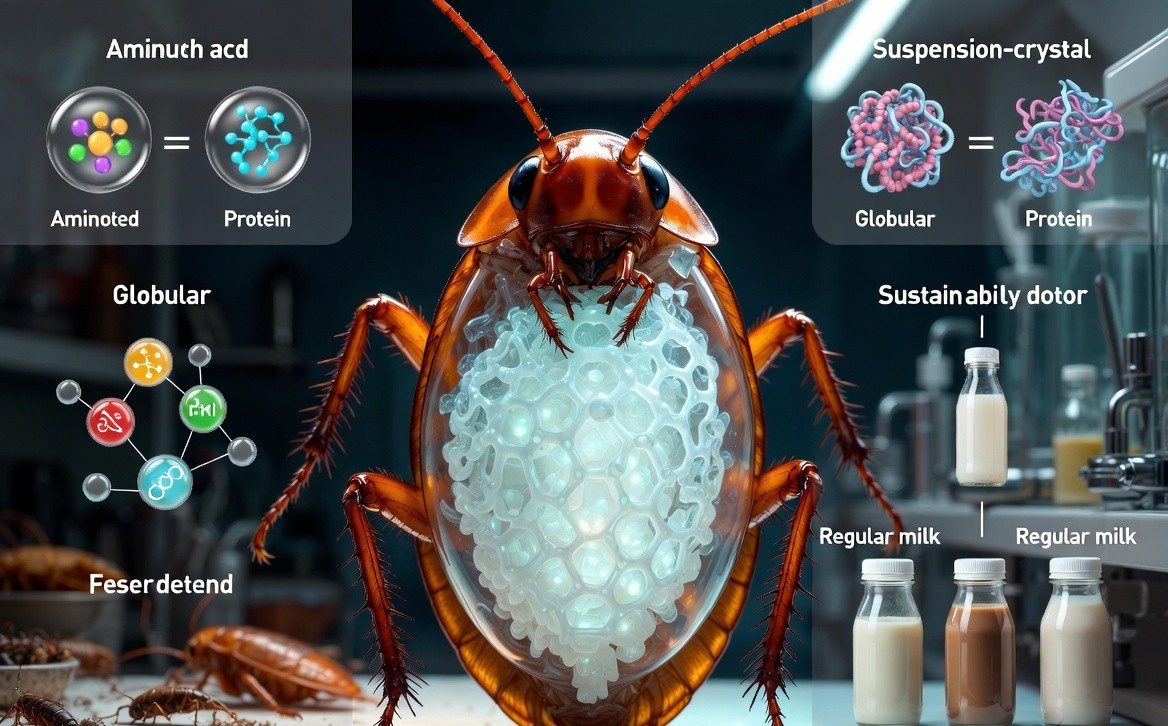
Deeper Dive: Why This Crystal is a Biochemical Marvel
To truly understand why the scientific community is excited—and not just disgusted—we need to look at the crystal’s structure on a molecular level.
Most proteins in food are globular; they unfold and digest quickly, leading to spikes in blood sugar and amino acids. The cockroach milk crystal, however, is a suspension-crystal. It’s a solid lipoprotein matrix that acts like a time-release capsule. As it passes through the digestive system, the outer layers are stripped away methodically, like peeling an onion.
In a 2024 computational modeling study, researchers simulated how human digestive enzymes interact with the crystal. The results were striking: the crystal resisted rapid breakdown, providing a steady stream of amino acids and lipids for over six hours. By comparison, a whey protein shake is fully digested in about 90 minutes.
This makes cockroach milk crystal an ideal candidate for:
- Endurance sports nutrition (marathoners, cyclists, military personnel)
- Medical recovery (patients unable to eat frequent meals)
- Severe food scarcity (where every calorie must be maximized)
The Complete Amino Acid Profile
Unlike many plant proteins (rice, pea, hemp) that lack one or more essential amino acids, cockroach milk contains all nine in ideal ratios. Specifically:
| Amino Acid | Role in Human Body | Present in Cockroach Milk? |
|---|---|---|
| Histidine | Tissue repair | ✅ High |
| Isoleucine | Muscle metabolism | ✅ High |
| Leucine | Protein synthesis | ✅ Very High |
| Lysine | Immune function | ✅ High |
| Methionine | Detoxification | ✅ Moderate |
| Phenylalanine | Neurotransmitter production | ✅ High |
| Threonine | Collagen production | ✅ Moderate |
| Tryptophan | Serotonin regulation | ✅ Moderate |
| Valine | Energy production | ✅ High |
For comparison, cow’s milk has a biological value (a measure of protein quality) of around 91. Cockroach milk has been estimated to exceed 100 on the same scale—meaning the body can utilize nearly every gram of protein ingested with minimal waste.
From Lab to Vat: How Yeast Makes Roach Milk
The genetic engineering process is fascinating and surprisingly elegant.
Step 1: Gene Identification
Scientists sequenced the genome of Diploptera punctata and located the specific gene responsible for producing the LiliM protein (the major component of the milk crystal).
Step 2: Yeast Transformation
Using CRISPR and other gene-editing tools, they inserted this gene into the DNA of Saccharomyces cerevisiae—common baker’s yeast. The yeast’s own cellular machinery now reads the roach gene as if it were its own.
Step 3: Fermentation
The engineered yeast is placed in stainless steel bioreactors (similar to those used for insulin production or plant-based heme for Impossible Burgers). They are fed a simple sugar solution. Over 48 hours, the yeast multiply and secrete the cockroach milk protein into the broth.
Step 4: Purification and Crystallization
The protein is filtered out, concentrated, and induced to form the same crystalline structure found in the insect’s gut. The result is a fine, off-white powder that contains pure cockroach milk protein.
Zero cockroaches are harmed. Zero cockroaches are involved beyond the initial gene sequencing.
The Space Food Revolution
NASA’s Advanced Food Technology Project has been following this research closely. The challenges of feeding astronauts on a three-year round trip to Mars are immense:
- Weight limits: Every kilogram of food requires rocket fuel. Current pre-packaged meals weigh too much.
- Shelf life: Food must last 5+ years without refrigeration.
- Nutrition retention: Vitamins degrade over time; freeze-dried food loses potency.
- Variety fatigue: Astronauts on the ISS already report boredom with the 200+ available meals.
Cockroach milk powder could solve multiple problems simultaneously. It is shelf-stable for years, ultra-lightweight (water can be added from recycled sources on the spacecraft), and provides complete nutrition in a small volume. A single kilogram of cockroach milk crystal contains more usable calories and protein than five kilograms of typical space rations.
Moreover, because it is produced via fermentation, astronauts could theoretically grow their own supply on board using a small bioreactor and a bag of sugar—closing the loop between waste CO₂ (to grow algae for sugar) and food production.
Famine Relief: The Ethical Case
The global population is projected to reach 9.7 billion by 2050. Traditional agriculture cannot scale to meet protein demand without catastrophic environmental damage. Livestock alone accounts for 14.5% of all human-caused greenhouse gas emissions.
Cockroach milk yeast fermentation offers a radical alternative:
- Land use: Zero arable land required. Bioreactors can be stacked vertically in urban centers.
- Water use: Approximately 1 liter of water per kilogram of protein. Compare to 15,000 liters for beef protein.
- Climate independence: No droughts, floods, or pests affect indoor fermentation.
- Speed: Yeast doubles every 90 minutes. A full batch of protein can be harvested in 2 days, not 2 years.
Humanitarian organizations like the UN World Food Programme have expressed cautious interest. The main barrier is not technical—it’s cultural and regulatory. But in a future where climate change disrupts wheat and soy harvests simultaneously, a vat-grown, shelf-stable, complete protein might be the difference between starvation and survival.
The “Yuck” Factor: Real and Persistent
Let’s be honest. The name “cockroach milk” is a marketing nightmare. Early focus groups conducted by a food-tech startup (which requested anonymity) reported visceral negative reactions. Words like “disgusting,” “unsafe,” and “poison” appeared frequently—despite participants being told the final product contains no insect parts.
This is a well-studied psychological phenomenon called the disgust response. Humans evolved to avoid rotten meat, feces, and insects because they historically carried pathogens. Even when rational knowledge overrides the fear, the limbic system fires anyway.
To bypass this, companies are exploring rebranding:
| Proposed Name | Pros | Cons |
|---|---|---|
| “Cockroach Milk” | Honest, scientifically accurate | High disgust factor |
| “Crystal Protein” | Neutral, sounds futuristic | Too vague; could be anything |
| “LiliM Protein” | Named after the gene LiliM | No consumer recognition |
| “Pacific Beetle Protein” | Geographic origin, less gross | Still has “beetle” |
| “DiploPro” | From genus Diploptera | Sounds like a prescription drug |
The most promising strategy may be to avoid naming the origin altogether and simply market the finished product as a “time-release fermented protein powder” with a neutral flavor. Just as most people don’t think “mold” when they eat blue cheese or “bacteria” when they eat yogurt, consumers may eventually accept cockroach milk protein as a normal ingredient in protein bars, sports drinks, and medical nutrition shakes.
Safety and Regulatory Hurdles
Before you see cockroach milk on shelves, several major hurdles remain:
1. Allergenicity Testing
Novel proteins must be screened for cross-reactivity. People with shellfish allergies (crustaceans are arthropods, like insects) may react to cockroach milk. Early data is mixed; some studies show low reactivity, others suggest caution. Large-scale human trials are needed.
2. Long-Term Feeding Studies
Rats fed the protein for 90 days showed no adverse effects in a 2023 study (not yet peer-reviewed). But 90 days is short. Chronic studies lasting 1-2 years are required for GRAS (Generally Recognized as Safe) status in the US or Novel Food approval in the EU.
3. Production Scaling
Current yield from yeast fermentation is low—about 0.5 grams of pure protein per liter of culture medium. To match the protein output of a single dairy cow (~30 kg protein per day), you would need 60,000 liters of fermenter volume. That’s doable (breweries do it daily), but the purification process is currently expensive.
4. Regulation
The FDA and EFSA have no existing category for “insect-milk analog produced in yeast.” Companies will need to petition for a new category, which could take 5-10 years and cost millions in safety dossiers.
Competitors on the Horizon
Cockroach milk is not the only novel protein being developed. It faces competition from:
- Precision-fermented whey (Perfect Day, others) — already on the market in ice cream. Tastes identical to dairy but lactose-free.
- Bean-free coffee (Atomo) — not a protein, but shows consumer willingness to accept lab-grown products.
- Cellular agriculture meat (Upside Foods, Good Meat) — approved in the US but struggling with cost.
- Insect protein powders (cricket, black soldier fly) — already sold as pet food and some human supplements, but growth is slow due to disgust.
Where cockroach milk wins is in caloric density and time-release structure. No other protein crystal currently exists in the food supply. That unique property could carve out a niche in medical and performance nutrition, even if it never becomes a commodity protein for the masses.
The Environmental Math
Let’s compare one liter of milk equivalent (in terms of protein content):
| Metric | Cow Milk | Soy Milk | Cockroach Milk (Yeast) |
|---|---|---|---|
| Land (m² per kg protein) | 15.2 | 2.1 | 0.03 |
| Water (L per kg protein) | 1,120 | 280 | 8 |
| CO₂e (kg per kg protein) | 9.8 | 0.9 | 0.4 |
| Time to produce (days) | 365 | 90 | 2 |
| Complete protein? | Yes | No (low methionine) | Yes |
The numbers are staggering. From a purely environmental perspective, cockroach milk yeast blows everything else out of the water. The only reason it doesn’t exist yet is our cultural revulsion and regulatory caution.
What Happens Next? A Timeline
- 2025-2027: Small-scale safety trials in rodents and then humans (likely in Singapore or Israel, where novel food regulations are more flexible).
- 2028-2030: First GRAS affirmation for use in medical nutrition (tube-feeding formulas, where taste is irrelevant and patients cannot object).
- 2031-2035: Introduction in sports nutrition as a “time-release crystal protein” with no mention of cockroaches on the label.
- 2035-2040: Potential use in emergency food aid and military rations.
- 2040+: Possibly, a mainstream ingredient in protein bars and meal replacements—if the disgust response fades with a generation raised on lab-grown foods.
The Philosophical Question
Ultimately, the cockroach milk discovery forces us to confront a deeper question: Are we willing to eat what is best for the planet, or only what feels familiar?
The Pacific beetle cockroach evolved this crystal over millions of years to do one thing perfectly: pack maximum nutrition into minimum volume. Humans, with our genetic engineering tools, have stolen that design. The resulting powder is ethically cleaner than dairy (no animals harmed), environmentally lighter than soy, and nutritionally superior to almost anything else.
The only remaining barrier is between our ears.
As one researcher put it in a 2024 interview with New Scientist: “We happily eat cheese that comes from a cow’s stomach lining. We drink beer fermented by yeast. We take insulin grown in E. coli. But a protein crystal from a cockroach gene, brewed in a vat, with no bugs anywhere? That’s where we draw the line?”
If history is any guide, the line will move. Lobster was once prison food. Sushi was once considered barbaric. Coffee was once banned as the devil’s drink. In fifty years, your grandchildren may look back at our disgust for cockroach milk and laugh—while sipping a crystal-protein smoothie on a Mars colony, powered by the tiny, brilliant design of an unassuming Pacific beetle.
Would you try cockroach milk protein if it were rebranded as a neutral, sustainable, time-release superfood? Or does the “yuck” factor win? The answer may determine how we eat in the coming decades