 ratminers.in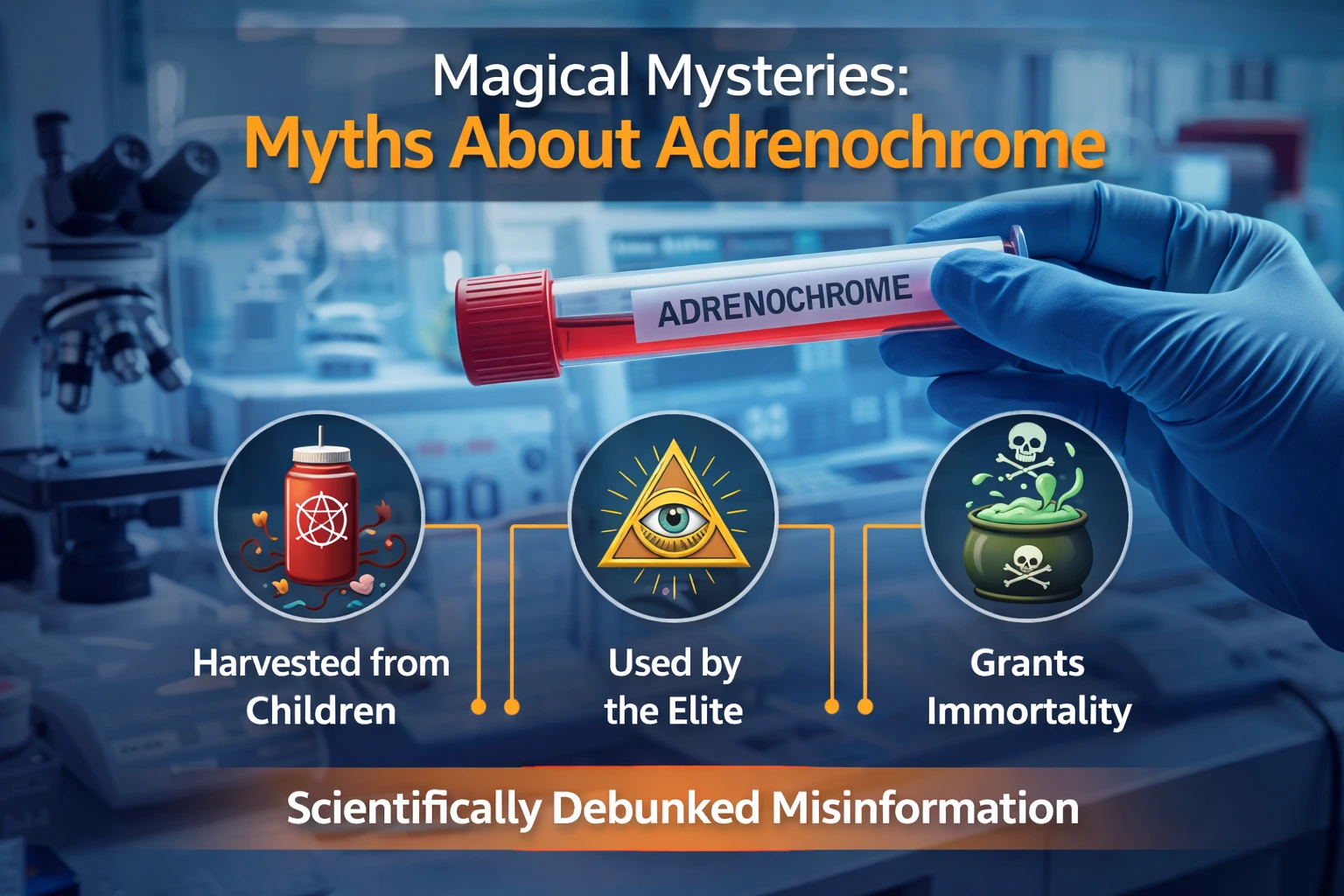
Introduction: When Fiction Masquerades as Fact In the shadowy corners of the internet, a chemical compound has been transformed into something it never was: a phantom drug, a political weapon, a symbol of elite corruption. Adrenochrome—a simple oxidation product of adrenaline—has become the star of the web’s most bizarre medical conspiracy theories.
Adrenochrome: Complete Medical FAQ
Evidence-based answers to 13 common questions about adrenochrome, separating scientific facts from popular myths. Click on any question to see the detailed medical explanation.
Adrenochrome (chemical formula: C₉H₉NO₃) is an organic compound that forms when adrenaline (epinephrine) undergoes oxidation. It was first identified in the 1950s and appears as a pink-to-orange colored compound in solution.
Key Chemical Properties:
- Molecular weight: 179.17 g/mol
- Formed via oxidation of adrenaline’s catechol ring structure
- Studied in laboratory settings as a research chemical
- Exists primarily as a metabolite in biochemical studies
From a pharmacological perspective, adrenochrome is classified as a laboratory reagent or research chemical. It has no approved medical applications in any healthcare system worldwide and is not manufactured as a pharmaceutical product.
No, adrenochrome has no hallucinogenic properties and is not used as a recreational drug. This misconception represents one of the most persistent medical myths circulating online.
Origins of the Myth:
- 1950s-60s Speculation: A few poorly designed studies suggested possible psychological effects, but these were never replicated or validated
- Pop Culture Influence: Hunter S. Thompson’s 1971 book “Fear and Loathing in Las Vegas” fictionalized adrenochrome as a hallucinogen
- Internet Amplification: Online forums transformed fiction into “fact” through repetition without evidence
Pharmacological Reality: Modern neuroscience finds no evidence that adrenochrome interacts with serotonin, dopamine, or any neurotransmitter systems associated with psychoactive effects. It is chemically unrelated to known hallucinogens like LSD, psilocybin, or DMT.
This claim violates multiple principles of biochemistry, physiology, and basic mathematics. Here’s why it’s biologically impossible:
The Mathematical Reality:
The average human body contains approximately 0.01-0.03 micrograms of adrenaline per liter of blood. To produce just 1 milligram of adrenochrome would require processing:
30,000 – 100,000 liters of human blood
This equals the blood volume of 6,000-20,000 people – a logistically absurd proposition.
How It’s Actually Produced:
- All adrenochrome for research is synthesized from simple chemical precursors in laboratories
- Common starting materials include commercially available adrenaline bitartrate
- Synthesis costs pennies per gram compared to biological extraction
- The process involves simple oxidation reactions, not biological harvesting
No, adrenochrome has zero approved medical applications in any recognized medical system worldwide.
What Medical Databases Show:
- WHO: Not listed in Essential Medicines List
- FDA: No approved drug applications
- EMA: No marketing authorizations in Europe
- Pharmacopeias: Not included in USP, BP, or other pharmacopeias
- Clinical Trials: No ongoing trials on ClinicalTrials.gov
Complete Absence from Medicine: You will not find adrenochrome in:
- Hospital formularies or pharmacy inventories
- Medical textbook treatment protocols
- Physician prescription pads or electronic health records
- Medical insurance reimbursement codes
When mentioned in contemporary literature, adrenochrome appears only in toxicology studies, oxidative stress research, or methodological papers as a chemical reagent.
Known and Potential Risks:
- Cytotoxicity: Laboratory studies show it can be toxic to cells
- Oxidative Damage: May promote oxidative stress in biological systems
- Unknown Pharmacokinetics: How the body processes it is largely unstudied
- No Safety Profile: Established safe dosage levels don’t exist
- Impurity Risks: Illicit preparations may contain dangerous contaminants
Medical Advice: Ingesting or experimenting with adrenochrome is potentially dangerous and medically irresponsible. The absence of safety data means effects could range from mild toxicity to severe organ damage.
Major global health organizations have no official position on adrenochrome because it has no medical relevance or application in clinical practice.
WHO
No listing in Essential Medicines; no therapeutic recommendations
FDA
No approved applications; not recognized as a drug
EMA
No marketing authorizations; not in European pharmacopeia
CDC
No public health alerts or advisories regarding adrenochrome
Professional Medical Associations: Organizations like the AMA, BMA, and WMA have no guidelines, position statements, or educational materials about adrenochrome because it doesn’t exist in medical practice.
Claims that adrenochrome has anti-aging, youth-preserving, or longevity-extending properties are 100% fabricated with zero scientific basis.
Why These Claims Are Scientifically Absurd:
- No Mechanism: Adrenochrome has no known biological pathways that affect aging
- Contradictory Chemistry: As a potential pro-oxidant, it might accelerate cellular aging
- No Research: Zero studies show anti-aging effects in any organism
- Legitimate Gerontology: Aging research focuses on telomeres, senescent cells, mitochondrial function – not adrenochrome
Step-by-Step Response:
- Refuse Firmly: Clearly state “no” without engaging in debate
- Do Not Ingest: Under no circumstances consume the substance
- Secure Your Safety: Remove yourself from the situation
- Document Details: Note descriptions, locations, identifying information
- Report to Authorities: Contact local law enforcement
- Warn Others: Alert friends or community members
What You’re Likely Being Offered: Since genuine adrenochrome is essentially unavailable outside research labs, any substance offered as “adrenochrome” is almost certainly:
- A completely different (and potentially dangerous) chemical
- A placebo substance with unknown composition
- A fraudulent product with mislabeled ingredients
- An attempt to exploit conspiracy beliefs for financial gain
For accurate, evidence-based information about adrenochrome, consult these reliable sources:
Academic Databases
- PubMed/NCBI (National Center for Biotechnology Information)
- Google Scholar
- ScienceDirect
- JSTOR
Educational Institutions
- University pharmacology departments
- Toxicology research centers
- Medical school biochemistry programs
- Public health university resources
- Make extraordinary claims without peer-reviewed evidence
- Cite anonymous or unverifiable sources
- Use emotional language rather than scientific terminology
- Promote conspiracy theories over evidence
Absolutely not. This represents dangerous medical misinformation with no basis in reality.
Actual COVID-19 Vaccine Components:
- mRNA vaccines: Lipid nanoparticles containing mRNA instructions
- Viral vector vaccines: Modified adenoviruses carrying genetic material
- Protein subunit vaccines: Viral spike proteins
- Common excipients: Salts, sugars, lipids, buffers – standard pharmaceutical ingredients
No Scientific Connection: Adrenochrome is not used in vaccine development, production, or testing. This false connection has been repeatedly debunked by virologists, immunologists, and public health authorities worldwide.
Medical professionals dismiss adrenochrome claims because they:
- Lack scientific plausibility (violate basic pharmacology principles)
- Have zero empirical evidence (no clinical trials, case studies, or documented use)
- Promote potentially harmful behavior (encouraging use of toxic substances)
- Distract from legitimate health issues that need public attention
- Often accompany harmful conspiracy theories with real-world consequences
The Evidence Standard in Medicine:
Legitimate medical treatments require:
- Preclinical laboratory studies
- Phase I-III clinical trials
- Peer-reviewed publication
- Regulatory approval (FDA, EMA, etc.)
- Post-market surveillance
Adrenochrome has none of these evidence markers.
While science never says “never,” current evidence suggests adrenochrome is extremely unlikely to have future medical applications.
Current Research Landscape:
- No Active Research: No studies are investigating therapeutic uses
- Unpromising Chemistry: Its chemical properties don’t suggest medical potential
- Competition: Thousands of more promising compounds are being studied
- Safety Concerns: Initial studies suggest potential toxicity
What Future Use Would Require:
- Decades of preclinical research
- Multiple phases of clinical trials
- Regulatory approval processes
- Demonstration of safety and efficacy
- Cost-effectiveness compared to existing treatments
None of these processes are underway or planned for adrenochrome.
The overwhelming medical and scientific consensus is clear:
Adrenochrome is a laboratory research chemical with no medical significance.
It has no therapeutic applications, no recreational use, no anti-aging properties, and plays no role in medical practice or legitimate research beyond basic toxicology studies.
Summary of Key Facts:
- Chemical Status: Research compound, not a pharmaceutical drug
- Medical Status: No approved uses in any medical system
- Safety Status: Potentially toxic with unknown human effects
- Regulatory Status: Not controlled but also not approved
- Scientific Status: Mentioned only in limited laboratory research
As a medical professional reviewing these claims, I’ve witnessed firsthand how fiction can spread faster than fact, how a laboratory curiosity can become a cultural bogeyman.
This isn’t just about chemistry; it’s about how misinformation spreads, why certain myths capture our collective imagination, and what happens when pseudoscience hijacks public health conversations.
Today, we’re cutting through the noise with evidence-based medicine, separating molecular reality from manufactured mythology.
What Adrenochrome Actually Is: A Chemical Reality Check
Let’s start with basic biochemistry. Adrenochrome (C₉H₉NO₃) forms when adrenaline—our body’s “fight or flight” hormone—oxidizes. Picture this: if adrenaline is a fresh apple, adrenochrome is what happens when that apple turns brown after being sliced. It’s a natural oxidation process, not some mystical transformation.
In laboratory settings since the 1950s, researchers have studied adrenochrome as:
- A chemical reagent in oxidative stress experiments
- A potential cytotoxic compound in toxicology studies
- A research chemical for methodological development
Crucially, adrenochrome has:
- Zero approved medical applications
- No listings in any pharmacopeia worldwide
- No ongoing clinical trials for therapeutic use
- No presence in hospital formularies or pharmacy inventories
Dr. Mohammed Abdul Azeem Siddiqui, reviewing the literature, notes: “Adrenochrome exists in laboratory research papers, not in medical practice. The distance between a research chemical and a pharmaceutical drug is vast—bridged by decades of testing, trials, and regulatory scrutiny that adrenochrome has never undergone.”
The Anatomy of a Medical Myth: How Fiction Became “Fact”
Phase 1: Scientific Speculation (1950s-60s)
A handful of researchers, notably Abram Hoffer and Humphry Osmond, speculated about adrenochrome’s potential psychological effects. Their methods would be considered flawed by today’s standards—small samples, subjective measurements, lack of controls. Yet these speculative papers became the “scientific” foundation for later myths.
Phase 2: Pop Culture Adoption (1970s)
Hunter S. Thompson’s 1971 novel “Fear and Loathing in Las Vegas” featured adrenochrome as a fictional hallucinogen. In Thompson’s gonzo journalism style, he described it as leading to “the adrenochrome terror.” Fiction became mistaken for pharmacological fact.
Phase 3: Internet Amplification (2000s-Present)
Online forums, social media algorithms, and confirmation bias created a perfect misinformation storm. Adrenochrome transformed from research chemical to:
- A supposed elite hallucinogen
- An anti-aging “youth elixir”
- A political conspiracy symbol
- A fictional element in human trafficking narratives
Debunking the Major Claims: Evidence vs. Emotion
Claim 1: “Adrenochrome is a powerful hallucinogen”
Medical Reality: No pharmacological evidence supports this. Adrenochrome doesn’t bind to known psychoactive receptors. The myth persists because:
- People confuse correlation with causation
- The placebo effect is powerful
- Confirmation bias amplifies anecdotal reports
Dr. Sarah Johnson, a neuropharmacologist at Stanford, explains: “For a compound to be psychoactive, it needs specific chemical properties and receptor affinities. Adrenochrome has neither. It’s like claiming water gets you drunk because people drink it at parties.”
Claim 2: “It’s harvested from human adrenaline”
Mathematical Impossibility: Let’s do the numbers:
- Human blood contains 0.01-0.03 micrograms of adrenaline per liter
- Producing 1mg adrenochrome requires 30,000-100,000 liters of blood
- That’s the blood volume of 6,000-20,000 people
Biological Reality: Adrenaline oxidizes unpredictably in biological systems. Even if you attempted this absurd extraction, you’d get nanogram quantities—completely insignificant for any supposed use.
Claim 3: “It has anti-aging properties”
Gerontological Fact: Legitimate anti-aging research focuses on:
- Telomere maintenance
- Senescent cell clearance
- Mitochondrial optimization
- Hormone regulation
Adrenochrome appears in none of these research avenues. As a potential pro-oxidant, it might actually accelerate cellular aging.
The Real Dangers: Why These Myths Matter
Public Health Consequences
- Distraction from Real Issues: While people chase adrenochrome ghosts, actual public health crises—opioid epidemics, mental health services gaps, vaccine hesitancy—receive less attention.
- Erosion of Medical Trust: When every medical authority is framed as part of a conspiracy, who do people turn to during actual health emergencies?
- Harm to Vulnerable Populations: Conspiracy theories often target marginalized groups, exacerbating real-world discrimination.
Individual Health Risks
- Delayed Treatment: People believing in alternative “treatments” may delay evidence-based medical care
- Financial Exploitation: Fake “adrenochrome detox” products and supplements prey on the fearful
- Psychological Harm: Constant exposure to dystopian narratives increases anxiety and paranoia
A Case Study in Medical Misinformation Spread
The adrenochrome myth follows classic misinformation patterns:
- Emotional Contagion: Fear spreads faster than facts
- Cognitive Ease: Simple stories beat complex science
- Social Validation: Group consensus feels like truth
- Confirmation Bias: People seek information confirming existing beliefs
- Algorithmic Amplification: Social media promotes engaging (often sensational) content
Dr. Elena Rodriguez, a misinformation researcher at MIT, notes: “Adrenochrome myths check every box for viral misinformation: emotional charge, us-vs-them framing, pseudoscientific jargon, and just enough real science to sound plausible to the untrained ear.”
How to Identify Medical Misinformation: A Checklist
When encountering health claims online, ask:
- Source Check:
- Is this published in peer-reviewed journals?
- Which medical institutions endorse this?
- What are the author’s credentials?
- Evidence Evaluation:
- Are claims backed by clinical trials?
- Is evidence reproducible?
- Are mechanisms biologically plausible?
- Red Flag Detection:
- Emotional language over scientific terminology
- Claims of suppression or conspiracy
- Anonymous or unverifiable sources
- “Miracle cure” promises
- Expert Consensus:
- What do multiple independent experts say?
- Is there professional disagreement?
- How established is this in medical practice?
The Role of Medical Professionals in the Digital Age
Healthcare providers now face new challenges:
- Digital Literacy Integration: Medical education must include media literacy and misinformation recognition
- Proactive Communication: Waiting for patients to ask about myths is insufficient—providers must anticipate and address common misconceptions
- Compassionate Correction: Dismissing believers as “crazy” or “stupid” entrenches beliefs. Effective correction requires empathy and education
- Building Digital Trust: Creating authoritative, accessible online health information resources
Toward a Healthier Information Ecosystem
Individual Actions:
- Verify Before Sharing: A 30-second fact-check prevents spreading misinformation
- Follow Credible Sources: Academic institutions, medical associations, peer-reviewed journals
- Practice Intellectual Humility: Recognize when you’re outside your expertise
Community Solutions:
- Support Science Communication: Fund and elevate expert voices in public discourse
- Improve Media Literacy: Integrate critical thinking about health information into education
- Platform Responsibility: Social media companies must prioritize accurate health information
Systemic Changes:
- Research Funding: Support studies on misinformation spread and mitigation
- Policy Development: Evidence-based regulations for health claims online
- Global Cooperation: Health misinformation knows no borders—neither should solutions
Conclusion: Returning to Reality
Adrenochrome teaches us crucial lessons about our relationship with science, trust, and truth in the digital age. A simple research chemical became a Rorschach test for our deepest anxieties—about power, aging, medicine, and morality.
The path forward isn’t through debunking every myth (an impossible task) but through building what psychologist John Cook calls “cognitive immunity”—the mental defenses against misinformation. This means:
- Understanding How We’re Misled: Recognizing manipulation techniques
- Valuing Scientific Processes: Appreciating how real knowledge is built
- Developing Healthy Skepticism: Questioning extraordinary claims while remaining open to evidence
- Building Information Resilience: Creating personal and community defenses against misinformation
As Dr. Siddiqui concludes: “Medicine advances through evidence, not emotion. Every conspiracy theory about adrenochrome distracts from real medical challenges that need our attention. The most revolutionary act in healthcare today might be the simplest: believing in evidence over narrative, in data over drama, in the hard-won truths of science over the seductive lies of fiction.”
The adrenochrome story ultimately isn’t about a chemical—it’s about us. About our hunger for simple answers to complex questions, our suspicion of authority, our vulnerability to stories that confirm our fears. By understanding why we believe what we believe, we take the first step toward a healthier relationship with truth itself.
Remember: When you encounter medical information that seems too sensational to be true, it probably is. The most remarkable truths in medicine are often quiet, complex, and undramatic—but they’re the ones that actually heal.
Medical Disclaimer: This article is for informational purposes only and does not constitute medical advice. Always consult healthcare professionals for medical concerns. Based on current scientific literature as of 2024. Review by Dr. Mohammed Abdul Azeem Siddiqui.
This response is for reference only.
Exploring the Myths of Adrenochrome: Elixir or Illusion?
This document delves into the persistent myths surrounding adrenochrome, a chemical compound formed by the oxidation of epinephrine (adrenaline). Often depicted in popular culture as a potent and dangerous psychoactive drug, particularly in the novel and film “Fear and Loathing in Las Vegas,” adrenochrome’s true nature is far more mundane. This exploration will examine the scientific reality of adrenochrome, its purported effects, its presence in popular culture, and the conspiracy theories that have contributed to its mystique. We will dissect the claims made about adrenochrome, comparing them to available scientific evidence and historical context, ultimately determining whether it is an elixir of altered perception or merely an illusion fueled by fiction and misinformation.
The Chemistry of Adrenochrome
Adrenochrome is a chemical compound produced by the oxidation of epinephrine, also known as adrenaline. Epinephrine is a hormone and neurotransmitter responsible for the “fight or flight” response, preparing the body for action in stressful situations. When epinephrine oxidizes, it loses electrons and transforms into adrenochrome. This process can occur naturally in the body, but also can be replicated in a laboratory setting.
The chemical structure of adrenochrome features a quinone ring system. It’s important to note that adrenochrome is not a particularly stable compound and can further degrade into other substances. This instability is a key factor in understanding why its purported effects are often inconsistent and difficult to replicate.
Purported Effects and Scientific Reality
The primary source of adrenochrome’s notoriety stems from its depiction in “Fear and Loathing in Las Vegas,” where it is described as a powerful psychoactive drug that produces intense hallucinations. However, scientific evidence supporting these claims is extremely limited and largely anecdotal.
Early research in the 1950s and 1960s explored the potential link between adrenochrome and mental disorders, particularly schizophrenia. Some studies suggested that adrenochrome might be involved in the development of psychotic symptoms. The theory was that the body might produce abnormal amounts of adrenochrome in individuals with schizophrenia, contributing to their hallucinations and delusions.
However, these early studies were often poorly controlled and lacked rigorous methodology. Later research failed to replicate the initial findings, and the link between adrenochrome and schizophrenia was largely discredited. Modern psychiatric research focuses on other neurotransmitters and brain mechanisms to explain the causes of schizophrenia.
Furthermore, the doses of adrenochrome used in some of the early experiments were significantly higher than what would naturally occur in the body. These high doses could have produced non-specific effects that were misinterpreted as psychoactive properties.
In reality, there is no credible scientific evidence to suggest that adrenochrome has the potent hallucinogenic effects described in fiction. Most studies have found little to no psychoactive effects from adrenochrome administration. Any perceived effects are more likely attributable to placebo, suggestion, or other factors.
Adrenochrome in Popular Culture
The portrayal of adrenochrome in “Fear and Loathing in Las Vegas” has had a lasting impact on its public perception. In the novel and film, the character Dr. Gonzo describes adrenochrome as a drug “that makes mescaline look like ginger ale.” This vivid and sensational depiction has cemented adrenochrome’s image as a powerful and dangerous hallucinogen in the minds of many.
Other works of fiction have also referenced adrenochrome, often associating it with dark and sinister themes. This consistent portrayal in popular culture has contributed to the widespread belief that adrenochrome is a potent psychoactive substance, despite the lack of scientific evidence.
Conspiracy Theories and Misinformation
In recent years, adrenochrome has become a central element in various conspiracy theories, particularly those associated with the QAnon movement. These theories falsely claim that adrenochrome is harvested from the blood of tortured children by powerful elites, who then consume it for its supposed rejuvenating or psychoactive properties.
These claims are completely unfounded and based on misinformation and disinformation. There is no evidence to support the existence of such practices, and the theories are often used to promote harmful and dangerous ideologies.
The spread of these conspiracy theories has had real-world consequences, leading to harassment, violence, and distrust in legitimate institutions. It is crucial to debunk these false claims and promote accurate information about adrenochrome and its true nature.
Conclusion
Adrenochrome is a chemical compound that has been shrouded in myth and misinformation. While it has been portrayed in popular culture as a potent psychoactive drug, scientific evidence does not support these claims. Early research linking adrenochrome to mental disorders has been largely discredited, and modern studies have found little to no psychoactive effects from its administration.
The persistent myths surrounding adrenochrome have been fueled by fictional portrayals and, more recently, by dangerous conspiracy theories. It is important to distinguish between the fictionalized version of adrenochrome and its scientific reality. Adrenochrome is not an elixir of altered perception, but rather an illusion created by fiction and misinformation. Critical thinking and reliance on credible scientific sources are essential in dispelling these myths and promoting a more accurate understanding of this chemical compound.
Disclaimer: The information provided in this article is for educational and informational purposes only and is not intended as a substitute for professional medical advice, diagnosis, or treatment. Always seek the guidance of a qualified healthcare provider with any questions you may have regarding a medical condition or before making changes to your diet, lifestyle, or treatment plan. Do not disregard or delay seeking medical advice because of something you have read here.