 ratminers.in
Telangana MBBS Web-Options 2026 · The 25‑Factor Guide
August 2026 — don’t rank colleges only by government/private status, quota, cutoff or city location.
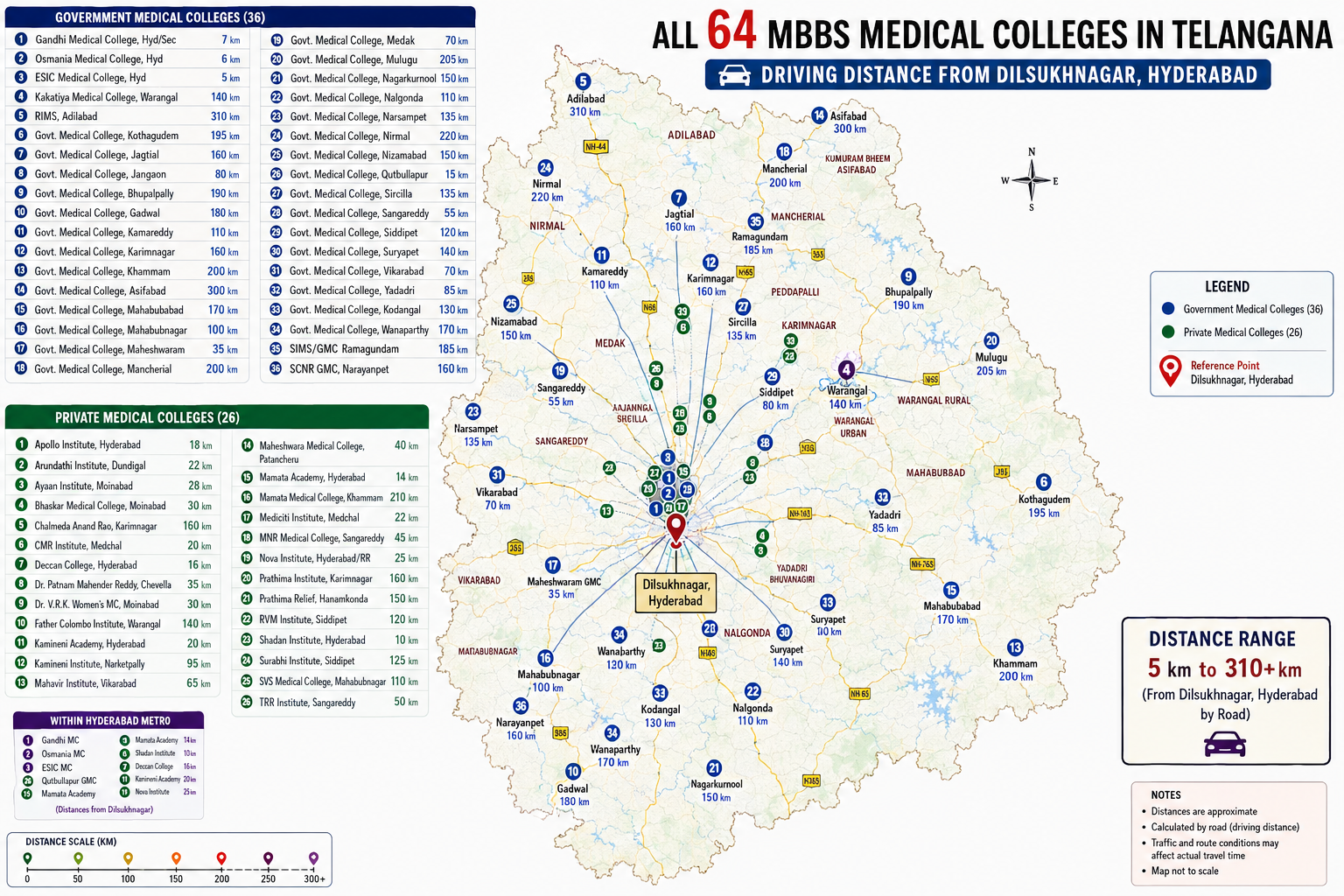
As of August 2026, this is especially important because Telangana has expanded its government medical-college network very rapidly. KNRUHS says several colleges were started in 2023–24, including Mulugu, Maheshwaram, Qutbullapur, Medak, Yadadri, Narsampet, Jogulamba Gadwal and Narayanpet. At the same time, recent reporting has highlighted infrastructure, faculty and clinical-exposure gaps in some newer colleges.
The 25 factors I would check before filling MBBS web options
1. Year the medical college started MBBS
- Year of establishment
- Year first MBBS batch started
- How many MBBS batches have graduated
- Whether the first batch has completed internship
- Whether the college has a mature academic system
Why it matters: A college that started 8–10 years ago has usually had more time to develop departments, faculty, laboratories, hostels, library, student systems and clinical services. But age alone should never decide the ranking.
2. Actual patient inflow — perhaps the MOST important factor
- Average daily OPD
- Average daily IPD
- Emergency/casualty patients
- Number of deliveries/month
- Major surgeries/month, Minor surgeries/month
- Orthopaedic, Paediatric, Medicine, General surgery, OBGYN cases
- Number of ICU patients, Trauma cases, Investigations performed
A 500-bed hospital with poor occupancy may provide less clinical exposure than a 300-bed hospital with very high patient turnover.
3. Bed occupancy
- Check separately from sanctioned bed strength
- Hospital A: 650 beds, 250 occupied vs Hospital B: 400 beds, 350 occupied → Hospital B better for clinical exposure
- Ask: “How many patients are actually present in the wards during a normal working day?”
4. Is the teaching hospital actually functioning as the clinical base?
- College → hospital distance
- Whether students walk/commute between them
- Whether transport is provided
- Whether clinical postings lose teaching time because of travel
- Whether the hospital is fully functional
- Whether all major departments are available
5. College’s own permanent building
- Is the college operating from its permanent campus or temporary/rented/repurposed buildings?
- Lecture theatres, Demonstration rooms, Department offices, Laboratories, Library, Examination halls, Anatomy dissection hall, Skill lab, Museum, Student common areas
6. Hostel status
- Government-owned hostel? On campus? Near hospital?
- Girls’ hostel, Boys’ hostel, number of rooms, students per room
- Mess, water supply, electricity backup, internet
- Security, CCTV, warden, night security, visitor restrictions, transport arrangements
Ask: “Where exactly is the hostel, and is it operational for my batch?”
7. Female candidate → safety should be a separate criterion
- Safe hostel, Female warden, 24×7 security, CCTV, secure hostel entry
- Safe route from hostel → college, Safe route from hostel → hospital
- College transport, Distance from town, Public transport, Nearby pharmacy, Nearby emergency care
- Lighting around campus, Security after evening/night duty
Ask current female students: “Would you personally recommend your hostel to your younger sister?”
8. Location and connectivity
- Distance from Hyderabad, Road quality, Bus availability, Railway station, Airport accessibility
- Nearest major town, Public transport, Distance to market, pharmacy, emergency hospital
- Mobile network, Internet
9. Can you realistically commute?
- Calculate door-to-door travel time, not just kilometres
- 60 km × two-way commute × 6 days/week can become exhausting
- Early morning postings, ward rounds and late clinical duties make daily long-distance travel undesirable
10. Basic-science laboratory quality
Anatomy: Dissection hall, Cadavers, Dissection tables, Embalming facilities, Anatomy museum, Histology lab
Physiology: Practical equipment, ECG, Spirometry, Hematology equipment, Experimental physiology facilities
Biochemistry: Semi-auto analysers, Spectrophotometers, Clinical chemistry equipment, Reagents, Practical laboratory capacity
11. Pathology, microbiology and pharmacology laboratories
- Number of microscopes, Histopathology facilities, Cytology, Microbiology culture facilities
- Autoclaves, Serology, Pharmacology practical equipment
- Animal-free teaching alternatives/simulation facilities, Availability of specimens/slides
Ask current students: “Do you actually perform the practicals, or are most demonstrations theoretical?”
12. Faculty strength — don’t trust only the college website
- Number of professors, Associate professors, Assistant professors, Tutors, Senior residents
- Faculty turnover, Vacant posts, Contract faculty
- Whether classes are regularly conducted
Ask: “Who actually teaches the students every day?”
13. Faculty-to-student ratio
- Calculate: Number of MBBS students ÷ actual teaching faculty
- A 50-seat college with adequate teachers may provide better individual attention than a rapidly expanding 150/200-seat institution
14. Availability of all major clinical departments
- General Medicine, General Surgery, Paediatrics, OBGYN, Orthopaedics, ENT, Ophthalmology, Dermatology
- Psychiatry, Anaesthesiology, Radiology, Emergency medicine, Pulmonology
- Cardiology, Nephrology, Neurology, Urology, Neurosurgery (where relevant)
The important word is functioning.
15. Emergency department / casualty exposure
- How many emergency patients per day? 24×7 casualty?
- Trauma exposure, Poisoning cases, Acute abdomen, Stroke, MI, Road traffic accidents, Obstetric emergencies
16. OT and surgical exposure
- Actual monthly numbers: General surgery, Orthopaedics, OBGYN, ENT, Ophthalmology
- Ask: “Do MBBS students actually get to observe/assist, or do they only attend theoretical postings?”
17. Delivery and obstetric exposure
- Deliveries/month, Normal deliveries, Caesarean sections
- High-risk pregnancies, Obstetric emergencies, NICU, Labour room exposure
18. Paediatric clinical material
- Paediatric OPD, Paediatric admissions, NICU, PICU
- Neonatal cases, Common childhood illnesses, Emergency paediatrics
19. Radiology and diagnostic facilities
- X-ray, Ultrasound, CT, MRI, Mammography where relevant
- Pathology, Microbiology, Blood bank, Biochemistry automation
Ask: “Are these facilities available inside the teaching hospital or are patients sent elsewhere?”
20. Blood bank
- Functional blood bank, Blood components, 24×7 availability
- Transfusion services, Blood storage, Emergency access
21. ICU and critical-care exposure
- Medical ICU, Surgical ICU, Paediatric ICU, NICU
- Emergency resuscitation, Ventilators, Critical-care cases
22. Internship quality
- Are interns actually posted in all departments? How many patients does an intern handle?
- Are procedures allowed? Is night duty excessive? Are interns supervised?
- Is accommodation available? Is stipend paid on time?
- Is internship structured or mostly service work?
Your college is not just the place where you study for five years. It is also your internship training environment.
23. Postgraduate departments
- Number of MD/MS seats, Number of PG departments, Senior residents
- PG academic activity: Case discussions, Seminars, Journal clubs, PG teaching
24. Academic environment and examination performance
- University results, First-year pass %, Second-year results, Final-year results
- Supplementary exam rate, Internal assessment system, Attendance enforcement
- Regularity of classes, Tutorial system, Mentorship
25. Student feedback — the final reality check
Speak to at least 3–5 current students: 1st year, 2nd year, 3rd year, Final year, Intern
- How many patients come daily? Are wards full?
- Are classes conducted regularly? Are professors available?
- Are physiology/biochemistry practicals properly conducted? Are cadavers available?
- Is hostel good? Is it safe for girls?
- How far is hostel from college & hospital? Is transport provided?
- Are clinical postings useful? Do interns get hands-on experience?
- Are faculty vacancies a problem?
- What is the one biggest disadvantage of this college?
- If you had the same NEET rank again, would you choose this college again?
⭐ How I would score Telangana colleges before web options
Instead of simply saying Government > Private, I would use a 100-point system.
| Factor | Weight |
|---|---|
| Patient inflow & clinical exposure | 20 |
| Hospital functionality & bed occupancy | 10 |
| Faculty availability | 10 |
| Permanent infrastructure | 8 |
| Labs & practical equipment | 7 |
| Hostel quality & availability | 7 |
| Female/student safety | 7 |
| Location & transport | 5 |
| Emergency/OT/ICU exposure | 5 |
| Internship quality | 5 |
| Academic environment/results | 5 |
| PG departments & senior residents | 3 |
| Library/skills lab/research | 3 |
| College age/maturity | 3 |
| Student satisfaction/reputation | 2 |
| TOTAL | 100 |
Interpretation:
85–100 → Excellent preference
75–84 → Strong preference
65–74 → Good/acceptable
55–64 → Consider carefully
Below 55 → Backup only unless there is a compelling personal reason
🚨 Special rule for NEW Telangana Government Medical Colleges
A new government medical college should not automatically be placed above an established private Category-A college.
New-GMC checklist — investigate these 10 things:
- ☐ Permanent college building operational?
- ☐ Permanent hospital operational?
- ☐ Hostel operational?
- ☐ Girls’ hostel operational?
- ☐ Hostel within safe distance?
- ☐ College–hospital distance reasonable?
- ☐ Daily OPD adequate?
- ☐ Daily IPD/bed occupancy adequate?
- ☐ All departments have faculty?
- ☐ Physiology/Biochemistry/Anatomy labs fully equipped?
If 3–4 of these are weak, do not blindly prefer the college simply because it is government.
🔴 Your examples: Mulugu, Qutbullapur, Maheshwaram, Vikarabad
- Mulugu, Maheshwaram, Quthbullapur: 50-seat government colleges (KNRUHS)
- Vikarabad: 100-seat GMC
- GMC Quthbullapur: NMC permission in 2024 — very young institution
- GMC Maheshwaram: New medical college with 50 MBBS seats; faculty recruitment still underway (August 2026)
These colleges deserve individual due diligence rather than being treated as one category.
🟢 The most important distinction
🟢 Category A — Mature, clinically strong college
Older institution, large hospital, strong patient flow, established departments, experienced faculty, PG departments, functional laboratories, established hostel, strong internship exposure. These should generally be high in the web options.
🟡 Category B — New GMC but clinically developing
Government fees, good future potential, reasonable hospital, developing infrastructure, some faculty gaps, hostel/transport issues, new laboratories, limited PG ecosystem. These require individual investigation.
🔴 Category C — New/weak clinical ecosystem
Temporary buildings, hostel not operational, college far from hospital, poor transport, low patient flow, faculty vacancies, incomplete laboratories, poor practical equipment, limited emergency/OT exposure, weak internship environment. Don’t put such a college high merely because it is a GMC.
⭐ A very important rule for web options
Don’t ask: “Which college can I get?”
Ask: “Among the colleges I can get, which gives me the best 5.5-year medical education?”
2026 Reality Check: For every college, check these five numbers:
- OPD/day
- IPD/day
- Bed occupancy
- Faculty actually working
- Hostel status
Those five figures will often tell you more than the college’s name, age, building photographs or reputation.
📅 1. Year the medical college started MBBS
- Year of establishment
- Year first MBBS batch started
- How many batches have graduated
- First batch completed internship?
- Mature academic system?
👥 2. Actual patient inflow — MOST important
- Avg daily OPD, IPD, emergency/casualty
- Deliveries/month, major/minor surgeries
- Ortho, paeds, medicine, surgery, OBGYN cases
- ICU patients, trauma, investigations
🛏️ 3. Bed occupancy
- Check separately from sanctioned beds
- Hospital A: 650 beds, 250 occupied
- Hospital B: 400 beds, 350 occupied → better
🏥 4. Teaching hospital functioning?
- College–hospital distance
- Transport provided?
- Clinical postings lose time due to travel?
- Hospital fully functional? All departments?
🏗️ 5. Permanent building or temporary?
- Permanent campus vs temporary/rented
- Lecture halls, demo rooms, labs, library
- Dissection hall, skill lab, museum
🛏️ 6. Hostel status
- Government hostel? On campus? Near hospital?
- Girls/boys hostel, rooms, students/room
- Mess, water, electricity, internet, security
👩 7. Female safety as separate criterion
- Safe hostel, female warden, 24×7 security
- Safe routes to college & hospital
- Transport, lighting, night security
📍 8. Location & connectivity
- Distance from Hyderabad, road quality
- Bus, railway, airport, public transport
- Market, pharmacy, emergency hospital nearby
🚗 9. Realistic commute?
- Door‑to‑door travel time
- 60 km × two‑way × 6 days = exhausting
- Early postings & night duties make daily commute hard
🧪 10. Basic‑science lab quality
- Anatomy: dissection hall, cadavers, histology
- Physiology: ECG, spirometry, equipment
- Biochemistry: analysers, spectrophotometers
🔬 11. Path, micro, pharma labs
- Microscopes, histopathology, cytology
- Culture facilities, autoclaves, serology
- Pharmacology practical equipment
👨⚕️ 12. Faculty strength (don’t trust website)
- Professors, associate/assistant professors
- Tutors, senior residents
- Vacancies, contract faculty, class regularity
📊 13. Faculty‑to‑student ratio
- Calculate: students ÷ actual teaching faculty
- 50‑seat college with adequate teachers → better attention
🏥 14. All major clinical departments
- Medicine, Surgery, Paeds, OBGYN, Ortho, ENT, Ophtha
- Psychiatry, Anaesthesia, Radiology, Emergency
- Cardiology, Nephrology, Neuro, Uro, Neurosurgery
🚨 15. Emergency / casualty exposure
- Emergency patients/day, 24×7 casualty?
- Trauma, poisoning, acute abdomen, stroke, MI, RTA, obstetric emergencies
🔪 16. OT and surgical exposure
- Monthly numbers: Gen Surg, Ortho, OBGYN, ENT, Ophtha
- Do students observe/assist or just theoretical?
🤱 17. Delivery & obstetric exposure
- Deliveries/month, normal & C‑section
- High‑risk, obstetric emergencies, NICU, labour room
👶 18. Paediatric clinical material
- Paeds OPD, admissions, NICU, PICU
- Neonatal, common childhood illnesses, emergency paeds
📷 19. Radiology & diagnostics
- X‑ray, USG, CT, MRI, mammography
- Path, micro, blood bank, biochemistry automation
🩸 20. Blood bank
- Functional, 24×7, components, transfusion, storage
🫀 21. ICU & critical care
- MICU, SICU, PICU, NICU, resuscitation, ventilators
🩺 22. Internship quality
- Postings in all depts, patient load, procedures
- Night duty, supervision, accommodation, stipend
- Structured or service work?
🎓 23. PG departments & academic ecosystem
- MD/MS seats, PG depts, senior residents
- Case discussions, seminars, journal clubs
📚 24. Academic environment & exam performance
- University results, pass %, supplementary rate
- Internal assessment, attendance, regularity, tutorials
🗣️ 25. Student feedback — final reality check
- Talk to 3‑5 current students (1st yr to intern)
- Patients, wards, classes, professors, labs, hostels
- Transport, clinical postings, internships
- Biggest disadvantage? Would you choose again?